Why in the News?
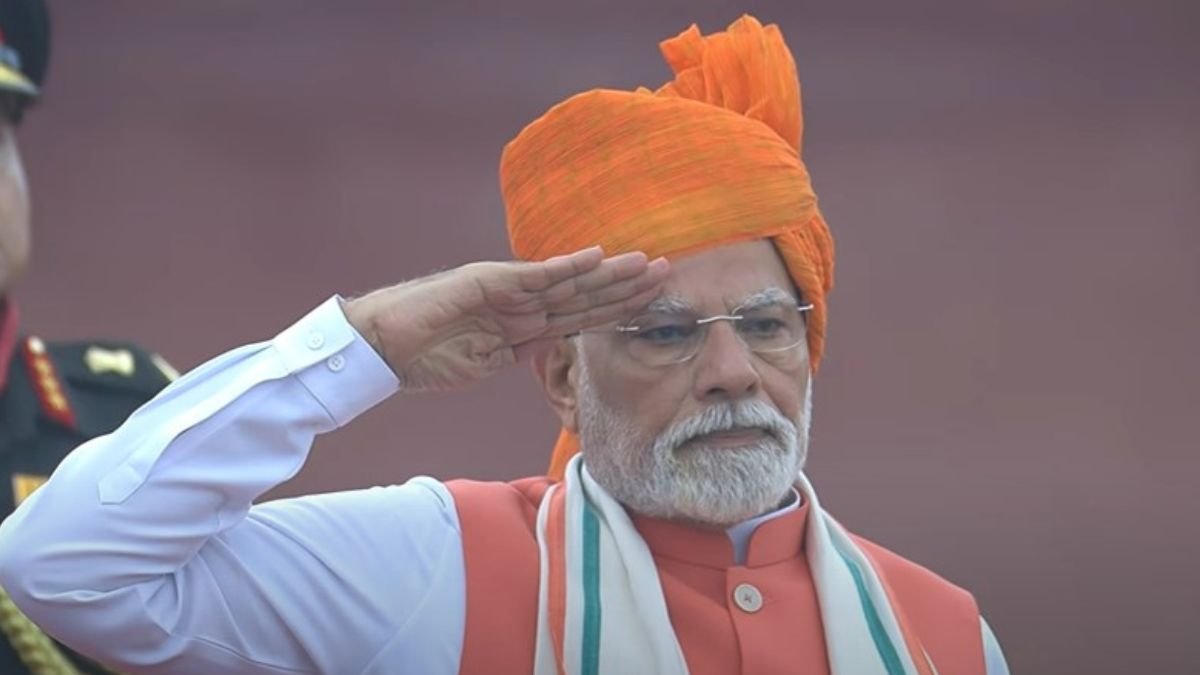
- In his Independence Day address, Prime Minister Narendra Modi stressed that self-reliance (aatmanirbharta) is the true basis of a nation’s self-respect (aatma samman).
- He announced a set of reforms focused on strengthening both economic and security frameworks.
- Modi clarified that self-reliance goes beyond import–export balances or currency concerns, and is rooted in India’s own strengths and capabilities.
- He also warned against attempts to alter the country’s demographic profile.
- The speech gained significance in the backdrop of the U.S. President Donald Trump’s recent move to impose a 50% tariff on Indian goods.
- He asserted that India’s growth must come from its own strength, not from weakening others, while pointing to the “economic greed” of certain countries (without naming them).
Security Related Reforms
- Development in Defence and Economic Sectors is seen as a key pillar of a developed India.
- Operation Sindoor & Self-Reliance
- PM Modi described Operation Sindoor as a landmark demonstration of India’s strategic autonomy and self-reliance in defence.
- Indian armed forces used indigenously developed weapons to dismantle terror networks and Pakistan-based infrastructure.
- He stressed that India will no longer bow to nuclear blackmail or foreign-imposed conditions.
- Missile Systems & Strategic Autonomy
- India currently operates three S-400 missile systems procured from Russia.
- These systems were crucial in intercepting Pakistani drones and missiles aimed at more than 15 Indian cities during Pakistan’s retaliation for Operation Sindoor in May 2025.
- The Integrated Air Command and Control System (IACCS) helped India maintain air superiority over Pakistan.
- Self-Reliance as National Strength
- PM Modi declared that indigenous capabilities allow India to act decisively and independently, making self-reliance the foundation of national security.
- He called self-reliance the bedrock of strength, dignity, and India’s journey to becoming a developed nation by 2047.
- The PM urged innovators and youth to focus on developing indigenous jet engines, drawing parallels with India’s successes in COVID-19 vaccines and the UPI revolution.
- He framed it as a direct challenge for Indian scientists and youth.
- Sudarshan Chakra (Shield Weapon System)
- India plans to develop its own indigenous air defence system by 2035 as national security cannot be dependent on foreign countries.
- It will strengthen India’s strategic autonomy by enabling precise counter-strikes while ensuring complete security for both critical defence assets and civilian infrastructure such as hospitals and railway stations.
- It is called ‘Sudarshan Chakra’ in honour of Lord Krishna’s mythological shield.
- It is an advanced multi-tiered air defence system.
- It will provide complete security coverage through modern technology.
- Indus Waters Treaty
- On the treaty, PM Modi stated firmly: “Blood and water will not flow together.”
- He called the treaty unjust, arguing that Indian farmers suffered while enemy lands were irrigated.
- He affirmed that India will no longer compromise on national interests.
Economic Reforms
- Goods and Services Tax (GST) Reforms
- GST was introduced in July 2017.
- After 8 years, the Prime Minister has announced second-generation GST reforms.
- These reforms aim to reduce the prices of essential goods.
- The 12% and 28% GST slabs will be removed.
- 99% of items in the 12% slab will move to the 5% rate.
- 90% of items in the 28% slab will move to the 18% rate.
- The rates will be:
| Current Slabs | Proposed Slabs |
| 1. 0.25% (diamonds and semi-precious stones)
2. 3% (jewellery and precious items) 3. Others: 5%, 12%, 18%, 28% and compensation cess ( extra tax levied on luxury and sin goods under GST to compensate states for revenue loss during the transition to the new tax system). |
1. Concessional rate – below 1% (only for items earlier in 0.25% and 3% slabs)
2. Mains slabs: 5% and 18% 3. 40% rate applicable on only 5-7 sin goods (products considered harmful to health or society, like tobacco, alcohol, pan masala, and aerated drinks, on which higher taxes are imposed to discourage their use). |
- No additional cess will be levied over and above GST rate.
- Additional Cess: Tax charged over and above the regular GST rate on certain goods or services, usually to raise funds for specific purposes (e.g., infrastructure, disaster relief, etc).
- Impacts of these reforms:
- It will reduce the revenue of the government in the short run but the decrease is not that large that it will impact the fiscal deficit of the government.
- Lower GST rates may raise consumption, reduce tax evasion and widen the tax net.
- In the long run, it may lead to increased revenues.
- As per the Ministry of Finance, this proposal of GST rationalisation and reforms has been sent to a group of ministers (constituted by GST council) to examine the issue.
- The GST council will try to implement the majority of reforms within this financial year.
- The centre will also engage with the states to achieve a consensus on these reforms.
- To promote “ease of living”, the Centre has proposed using technology to make GST processes smoother—by speeding up registration, introducing pre-filled returns to avoid errors, and ensuring quicker, automated refunds with less manual work.
- Pradhan Mantri Viksit Bharat Rozgar Yojana
- The scheme aims to create more jobs and boost formal employment in India as part of the Viksit Bharat 2047 vision.
- This is an employment-linked incentive scheme. In this, the incentive is given to both employers (for creating jobs) and employees (for shifting from informal to formal sector).
- A new corpus of ₹1 lakh crore will be created which would give a ₹15,000 one-time grant to first-time employees in the private sector and incentives to the private sector to create employment.
- MSME Sector
- The government aims to reduce compliance costs for micro, small, and medium enterprises (MSMEs).
- Compliance cost refers to the money, time, and effort that businesses spend to follow government rules, regulations, and paperwork.
- It also seeks to remove the fear of arbitrary legal action so that these enterprises can function more freely.
- These measures are expected to strengthen the MSME sector, which is one of the largest job creators in the country.
- Agriculture
- The Prime Minister assured that he would protect the interests of Indian farmers, even in the face of global trade pressures like U.S. tariff negotiations.
- He stressed the urgent need to reduce India’s dependency on imported fertilizers to safeguard farmers and ensure agricultural self-reliance.
Science and Technology Reforms
- Dependence on Imports: The Prime Minister noted that a large portion of India’s budget goes toward procuring fuel and energy from abroad, stressing the need for self-reliance in energy.
- Nuclear Energy Expansion: By 2047, India aims to increase nuclear energy capacity more than tenfold, supported by the development of 10 nuclear power plants.
- Critical Minerals Mission: The government launched the National Critical Minerals Mission to explore 1,200 sites, ensuring access to essential minerals for energy, technology, and manufacturing.
- Clean Energy & Renewables: Emphasis was placed on expanding solar and wind energy, along with strengthening domestic clean energy initiatives for sustainable growth.
- Technological Self-Reliance: Self-reliance in key sectors such as semiconductors, defence, medicines, space, deep-sea exploration, IT, and nuclear energy was described as the foundation of a Viksit Bharat by 2047.
- Semiconductor Development:
- A made-in-India semiconductor chip is expected to reach the market by the end of this year (2025), reducing dependence on imports.
- Six semiconductor units are already on the ground, and four new units have been given approval.
- Deep Ocean Mission: India’s Samudrayaan Mission aims to send three divers in an indigenous submersible to 6,000 metres below the ocean surface, building on recent deep-sea trials by Indian aquanauts.
- Space Advancements:
- Astronaut Shubhanshu Shukla recently journeyed to the International Space Station.
- The Gaganyaan Mission is scheduled to send Indian astronauts into space by 2027.
- Over 300 Indian startups are actively engaged in the space sector, generating jobs and innovation.
- Youth & R&D Appeal: The Prime Minister urged young scientists, engineers, and professionals to contribute to complex fields such as fighter jet engines, pharmaceuticals, and biotechnology.
- He highlighted India’s BioE3 Policy and called upon youth to study and innovate under it.
| BioE3 Policy
1. The BioE3 Policy stands for Biotechnology for Economy, Environment, and Employment. 2. It provides a roadmap for promoting sustainable biomanufacturing in India, using biotechnology to grow the economy, protect the environment, and generate jobs. 3. Main Goals a. High-performance biomanufacturing: Establish shared facilities like Biofoundries, Bio-AI hubs, and biomanufacturing centers to convert research into real products. b. Green growth & circular economy: Shift from traditional industries to regenerative, bio-based manufacturing that recycles and reduces environmental impact. 4. Key Focus Areas: BioE3 targets innovation across six domains: a. High-value bio-based chemicals, biopolymers, and enzymes b. Smart proteins and functional foods c. Precision biotherapeutics (advanced medicines) d. Climate-resilient agriculture e. Carbon capture and its utilization f. Marine and space biotechnology 5. Real-World Application Highlight: Under this policy, India will conduct its first-ever biological experiment on the International Space Station (ISS) to study human life sustainability in space—a milestone enabled by the BioE3 framework. |
Demographic Mission
- Anti-Naxal operations in Chhattisgarh have converted former conflict areas into green zones.
- Demographic Changes:
- Rising concerns about illegal migration and infiltration, particularly from Bangladesh, and its impact on border districts.
- These demographic shifts are viewed as challenges to security, stability, and development.
- Previous Reports: Police and security agencies have earlier highlighted demographic changes in districts along the Nepal and Bangladesh borders.
- Studies and reports (using Census, NFHS, voter lists, and local surveys) indicated that population shifts in border villages and sub-divisions could pose long-term challenges for governance and security.
- Illegal migration/infiltration is seen as:
- Snatching away livelihood opportunities.
- Targeting vulnerable groups (e.g., women and tribals).
- Altering the demographic balance in sensitive areas.
- These changes may:
- Hamper unity, integrity, and progress of the nation.
- Create social tensions if left unaddressed.
- Pose a direct threat to national security, especially in border belts.
- High-Powered Demographic Mission
- A new Demographic Mission has been announced to address issues of population shifts, migration, and related challenges.
- The Mission aims to safeguard livelihoods, land rights, and community security, especially in sensitive areas.
- The Mission will work in a planned and time-bound manner.
Women – Not only Beneficiaries but Drivers of Growth
- PM Modi stated that women are not only beneficiaries of India’s rising economy but also key contributors to its growth.
- He honoured the visionaries who drafted the Constitution, highlighting the important contributions of women leaders like Hansa Mehta and Dakshayani Velayudhan in strengthening its foundation.
- He highlighted that every sector now acknowledges the power of women (nari shakti).
- From start-ups and the space sector to sports and the armed forces, women are making their mark and standing shoulder to shoulder in nation-building.
- Special mention was made of the first batch of women cadets graduating from the NDA, which he called a historic moment of national pride.
- Empowerment through SHGs
- He praised the role of self-help groups (SHGs) in transforming women’s lives.
- Programmes like ‘NaMo Drone Didi’ have given rural women a new identity.
- He announced that 2 crore women have already become ‘Lakhpati Didis’ under the Lakhpati Didi Yojana, which helps SHG members achieve an annual household income of ₹1 lakh or more.
Implications
- Strategic Autonomy: Indigenous defence and air defence systems like Sudarshan Chakra reduce dependency on imports and enhance national security.
- Economic Transformation: GST reforms and MSME support lower compliance costs and boost consumption-led growth.
- Technological Advancement: Push for semiconductors, nuclear power, deep ocean, and space missions strengthen India’s knowledge economy.
- Social Stability: Demographic Mission and women empowerment initiatives aim to safeguard unity and promote inclusive development.
- Environmental Sustainability: BioE3 Policy and renewable energy focus align with India’s net-zero and green growth goals.
Challenges & Way Forward
| Challenges | Way Forward |
| Heavy import dependence in energy, defence, and semiconductors | Accelerate domestic R&D and incentivize private sector participation |
| Short-term revenue loss from GST reforms | Widen tax base, improve compliance through tech–enabled GST system |
| Rising demographic pressures and migration in border areas | Strengthen border management, conduct periodic demographic surveys, safeguard land and livelihood rights |
| Limited MSME competitiveness in global value chains | Provide credit access, reduce compliance burden, promote digitalisation |
| Balancing rapid growth with sustainability goals | Ensure circular economy, invest in green technologies, expand renewable energy |
Conclusion
PM Modi’s 103-minute Independence Day address, the longest ever by an Indian Prime Minister, laid out a comprehensive roadmap for a Viksit Bharat by 2047. By emphasizing self-reliance across defence, economy, technology, and society, he framed it as both a strategy for growth and a shield for national dignity. As India strengthens indigenous capabilities, from GST reforms and MSME empowerment to BioE3 and Sudarshan Chakra, the vision aligns with the constitutional values of inclusive growth and national integrity, echoing the contributions of past leaders and women visionaries.
| Ensure IAS Mains Question
Q. “Self-reliance is not just about reducing imports but about strengthening India’s own capabilities.” Discuss in the context of recent reforms announced by the government. (250 words) |
| Ensure IAS Prelims Question
Q. With reference to the recently announced GST reforms, consider the following statements: 1. The 12% and 28% slabs will be merged into 18%. 2. Items in the 0.25% and 3% slabs will move into a new concessional slab below 1%. 3. No additional cess will be levied over and above GST rates under the new reforms. Which of the above statements are correct? a) 1 and 2 only b) 2 and 3 only c) 1 and 2 only d) 1, 2 and 3 Answer: b) 2 and 3 only Explanation: Statement 1 is incorrect: 12% and 28% slabs are not merged into 18%. Instead, items from these move largely into the 5% and 18% slabs. Statement 2 is correct: 0.25% and 3% slabs are merged into a new concessional slab (below 1%). Statement 3 is correct: No additional cess will be levied over and above GST rates |