1. Gulf of Aden
Why in the News?
- On August 3, 2025, a boat carrying 154 Ethiopian migrants sank near Yemen’s southern coast in the Gulf of Aden, killing at least 68 people and leaving 74 missing.
- This sea route is often used by migrants from East Africa to reach Gulf countries, but it is dangerous and controlled by smugglers.
- In 2024, over 60,000 migrants came to Yemen this way, and more than 500 people lost their lives during the journey.
About Gulf of Aden
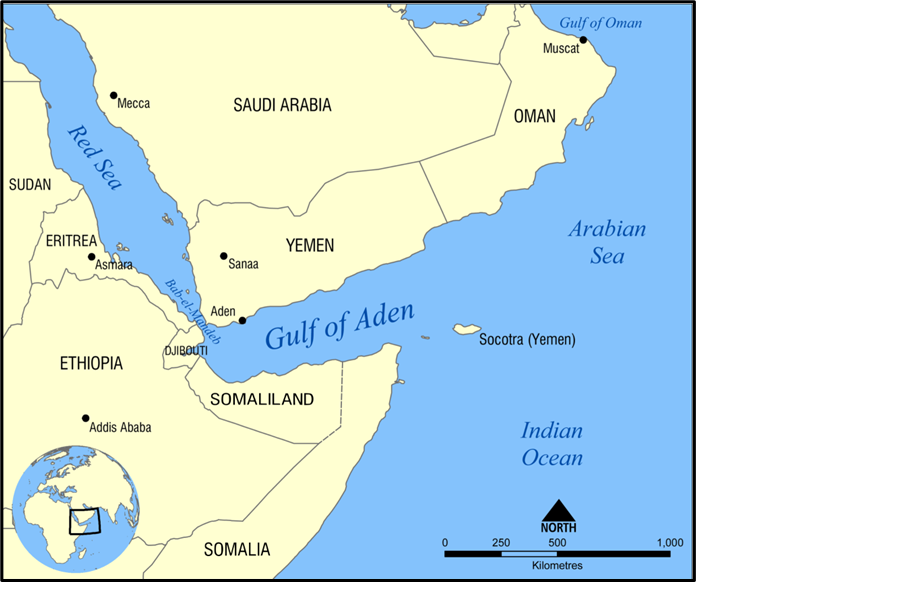 The Gulf of Aden is a part of the Indian Ocean, situated between the Arabian Peninsula to the north and the Horn of Africa to the south.
- It links the Red Sea with the Arabian Sea and eventually the Indian Ocean.
- The gulf gets its name from Aden, a port city on Yemen’s coast.
- It is about 900 km long, 500 km wide, and covers an area of roughly 1 lakh sq. km.
- It is bordered by Somalia and the Socotra Islands (Yemen) to the south, Yemen to the north, Arabian Sea to the east, and Djibouti to the west.
- Connected to the Somali Sea in the south via the Guardafui Channel, and to the Red Sea in the west through the Bab el-Mandeb Strait.
- In the west, it narrows into the Gulf of Tadjoura near Djibouti.
- Separated from the Arabian Sea by the Horn of Africa and the Socotra Islands.
- The main underwater feature is the Sheba Ridge, part of the Indian Ocean ridge system, running through the gulf’s center.
- It has lower salinity compared to the nearby Red Sea.
- Important nearby cities include Aden, Mukalla, Ahnwar, Balhaf, Berbera, Bosaso, and Djibouti City.
- Major ports are Aden (Yemen), Berbera and Bosaso (Somalia).
- A key part of the Suez Canal shipping route, connecting the Red Sea and the Mediterranean Sea.
- Around 11% of global seaborne petroleum passes through it on the way to the Mediterranean or Arabian Seas.
2. Nyala, Sudan
Why in the News?
- In August 2025, a Sudanese air strike targeted Nyala Airport in the Darfur region, which is under the control of the Rapid Support Forces (RSF).
- The strike reportedly destroyed a suspected Emirati military aircraft, killed at least 40 suspected Colombian mercenaries, and destroyed arms and equipment allegedly sent from the UAE to the RSF.
- Sudanese officials called it a warning against foreign interference in the country’s conflict, while the UAE denied the allegations.
About Nyala, Sudan
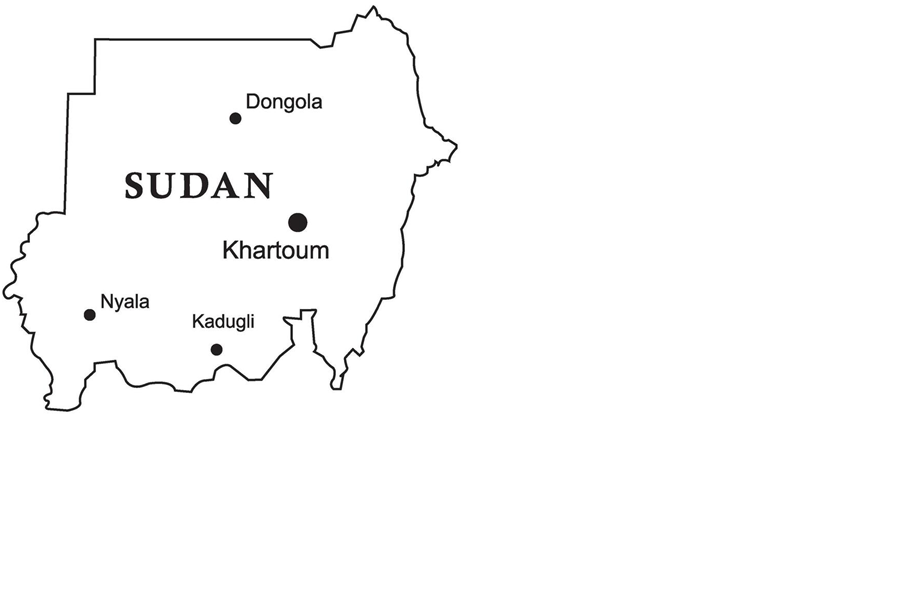
- Nyala is the capital of South Darfur and serves as a major trade and administrative center, historically known for its cosmopolitan character and diverse population.
- In the ongoing Sudanese conflict, the Rapid Support Forces (RSF) seized key areas of the city, including Nyala Airport, early in the fighting and later established full control.
- The conflict has caused mass displacement, with hundreds of thousands forced to flee and facing severe challenges in accessing humanitarian aid.
- Nyala’s past is shaped by social and political tensions, including disputes between settled communities and pastoralist groups, worsened by earlier government policies.
- The city’s current crisis is part of the broader Sudanese civil war that began in April 2023 between the Sudanese Armed Forces (SAF) and the RSF.
- Due to its location and infrastructure, Nyala holds strategic importance, especially its airport, which is vital for both civilian and military purposes.
About Sudan
- Sudan is a country in northeastern Africa
- Border Countries: South Sudan, Ethiopia, Eritrea, Egypt, Libya, Chad, and the Central African Republic.
- It lies along the Sahara Desert in the north and stretches southward to the forests of West Africa and the Congo River basin.
- The country has a significant Red Sea coastline, providing vital access to the Indian Ocean and the Mediterranean Sea via the Suez Canal.
- Capital: Khartoum, located at the confluence of the Blue Nile and White Nile
- Currency: Sudanese Pound (SDG).
- Colonial History: After Egyptian occupation in the early 19th century, the 1899 agreement established a joint British-Egyptian rule, though Britain held real control.
- Since independence in 1956 from Anglo-Egyptian co-rule, Sudan has largely been governed by military regimes promoting Islamic-oriented policies.
- For over a century, Sudan included the territory of present-day South Sudan, home to many sub-Saharan African ethnic groups.
- Before South Sudan’s secession in 2011, Sudan was Africa’s largest country, covering over 8% of the continent and nearly 2% of the world’s land area.
- Much of the nation is made up of deserts and arid grasslands, with vast plains and plateaus dominating its landscape.