Why in the News?
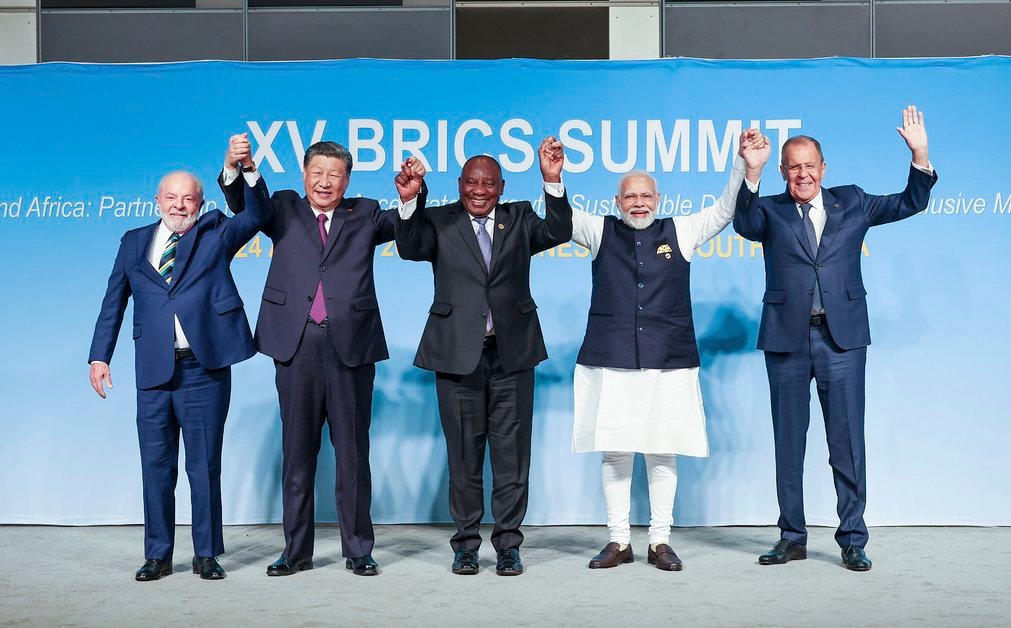
- The 17th BRICS Summit was held on 6–7 July 2025 in Rio de Janeiro, Brazil.
- The theme was “Strengthening Global South Cooperation for a More Inclusive and Sustainable Governance.”
- This summit ended with the ‘Rio de Janeiro Declaration’ and marked a turning point towards expansion, reform, and stronger unity among developing countries.
What are the Key Highlights?
- Expansion of BRICS:
- Indonesia officially joined BRICS as a full member.
- 11 new partner countries were welcomed: Belarus, Bolivia, Kazakhstan, Cuba, Nigeria, Malaysia, Thailand, Vietnam, Uganda, and Uzbekistan.
- With earlier members like Iran, Saudi Arabia, and UAE, BRICS now represents 45% of the global population and 44% of global oil production.
- India’s Role:
- India will host the 18th BRICS Summit in 2026.
- Prime Minister of India introduced a new vision of BRICS:
Building Resilience and Innovation for Cooperation and Sustainability. - India emerged as a strong voice for issues like climate finance, digital governance, de-dollarisation, and institutional reform.
- Global Governance and Peace:
- BRICS supported expansion of the UN Security Council to include more countries from Asia, Africa, and Latin America.
- Called for reforms in the IMF, World Bank, and WTO.
- Demanded a ceasefire in Gaza, supported a two-state solution, and condemned the Pahalgam terror attack in India.
- Rejected linking climate change with security threats.
- Economic and Financial Cooperation:
- BRICS launched the BRICS Multilateral Guarantee (BMG) to support infrastructure and climate investments.
- Discussed Cross-Border Payments Initiative to reduce reliance on the US dollar.
- Reviewed Strategy for BRICS Economic Partnership 2025 and welcomed the new Strategy for 2030.
- Climate and Sustainability:
- Adopted the Leaders’ Framework Declaration on Climate Finance.
- Signed an MoU on the BRICS Carbon Markets Partnership.
- Supported the Paris Agreement and UNFCCC.
- Welcomed Brazil’s hosting of COP-30 and supported India’s bid for COP-33 (2028).
- Technology and Innovation:
- Adopted Leaders’ Statement on Global Governance of AI.
- Agreed on Data Economy Governance Understanding.
- Formed the BRICS Space Council for joint space missions.
- Health and Social Development:
- Launched BRICS Partnership for the Elimination of Socially Determined Diseases (starting with Tuberculosis).
- Focused on youth empowerment, women’s rights, disability inclusion, and migration management.
- India-China Relations:
- The Prime Minister of India and the President of China agreed to de-escalate tensions along the LAC and resume border patrols, which may help restore investor confidence.
- US Opposition:
- The US warned of tariffs on countries that support BRICS’ “anti-American” stance.
- India clarified that it does not oppose the US dollar, but explores alternative settlement systems for practical reasons.
- India also refused to trade oil with Russia in Chinese yuan, resisting China’s growing monetary influence.
What are the Significances?
- More Inclusive Global Leadership: BRICS is pushing for better representation of developing countries in international bodies like the UN, IMF, World Bank, and WTO.
- Strengthening Global South Unity: With new members and partners, BRICS reflects the rise of the Global South and offers an alternative to Western-led platforms like the G7.
- Strategic Economic Power: BRICS now controls a large share of global oil and has growing influence on global trade, technology, and development finance.
- Neutral Space for Dialogue: BRICS offers countries like India and China a non-Western platform to engage diplomatically, especially during bilateral tensions.
- Voice for Peace and Fair Development: The group is promoting peace, climate justice, and people-centric development, especially for vulnerable regions.
What are the Challenges and Way Forward?
| Challenges | Way Forward |
| 1. Lack of permanent secretariat and structured decision-making. | Set up a BRICS permanent secretariat and adopt weighted voting on economic matters. |
| 2. Geopolitical contradictions among members (e.g., Iran vs. UAE, China vs. India). | Create clear membership criteria and issue-based cooperation to avoid internal deadlock. |
| 3. Weakening BRICS economies (China’s slowdown, Russia’s war-linked decline). | Focus on economic diversification and support small economies within BRICS. |
| 4. Intra-BRICS trade is still very low (just 2.2% in 2022). | Establish a BRICS+ Free Trade Agreement to boost internal trade. |
| 5. BRICS+ holds only 19% voting power in global financial institutions. | Push for voting reform in the IMF, World Bank, and WTO. |
| 6. Slow progress in de-dollarisation and no consensus on BRICS currency. | Expand bilateral currency agreements and build cross-border digital payment systems. |
| 7. Limited lending capacity of the New Development Bank. | Launch a BRICS+ Development Bank 2.0 with more funding and partnerships with other regional banks. |
| 8. Low visibility of BRICS’ soft power and cultural unity | Set up BRICS University Network, promote student exchanges, and offer visa-free travel blocs. |
Conclusion
The 17th BRICS Summit has shown that emerging nations are ready to play a bigger role in shaping global policies. While BRICS faces many challenges, it has the potential to become a strong voice for fairness, peace, and development. If the group strengthens its structure and deepens cooperation, it can become a major force in building a better global future.
BRICS |
|
| Aspect | Details |
| About | BRICS is a group of major emerging economies Brazil, Russia, India, China, and South Africa. |
| Origin of Term | The acronym ‘BRIC’ was coined by British economist Jim O’Neill in 2001 to describe fast-growing economies. |
| Formation as a Group | Started functioning as a formal group during the G-8 Outreach Summit in 2006. First summit held in Russia in 2009. |
| Inclusion of South Africa | South Africa joined in 2010, turning BRIC into BRICS. |
| Current Members | Brazil, Russia, India, China, South Africa, Iran, UAE, Egypt, Ethiopia, and Indonesia (joined in 2025). |
| Pending / Declined Members | Saudi Arabia has not yet formalised its membership. Argentina opted out in 2024. |
| Significance |
|
| Major BRICS Initiatives |
|
| Ensure IAS Mains Question:
Q. “BRICS is gradually evolving from a loose coalition into a structured platform aiming to reshape global governance from the perspective of the Global South.” Critically examine the strategic relevance of BRICS in today’s multipolar world. Discuss the challenges it faces in achieving institutional effectiveness and global influence. (250 words) |
Ensure IAS Prelim Question:Q. With reference to BRICS, consider the following statements:
Which of the statements given above is/are correct? A. 1 and 2 only Answer: CExplanation:Statement 1 is correct: The term ‘BRIC’ was coined by economist Jim O’Neill in 2001, while the group began functioning in 2006. Statement 2 is incorrect: Indonesia joined in 2025, but before that Iran, UAE, Egypt, and Ethiopia joined in 2024. Statement 3 is correct: BRICS accounts for 37.3% of global GDP, while G7 accounts for 29.3%. |