
Namibia
Why in the News?
- Namibia has recently come into the international spotlight as it is set to become the first foreign country to adopt India’s Unified Payments Interface (UPI).
- This significant development follows a licensing agreement signed in April 2024 between the National Payments Corporation of India (NPCI) and the Bank of Namibia.
- The announcement was made during the Indian Prime Minister’s landmark visit to Windhoek, where he held bilateral talks with Namibian President Netumbo Nandi‑Ndaitwah.
- This move marks a major step in deepening Indo-Namibian relations and highlights India’s growing role in global digital transformation.
What are the Key HIghlights?
- Location:
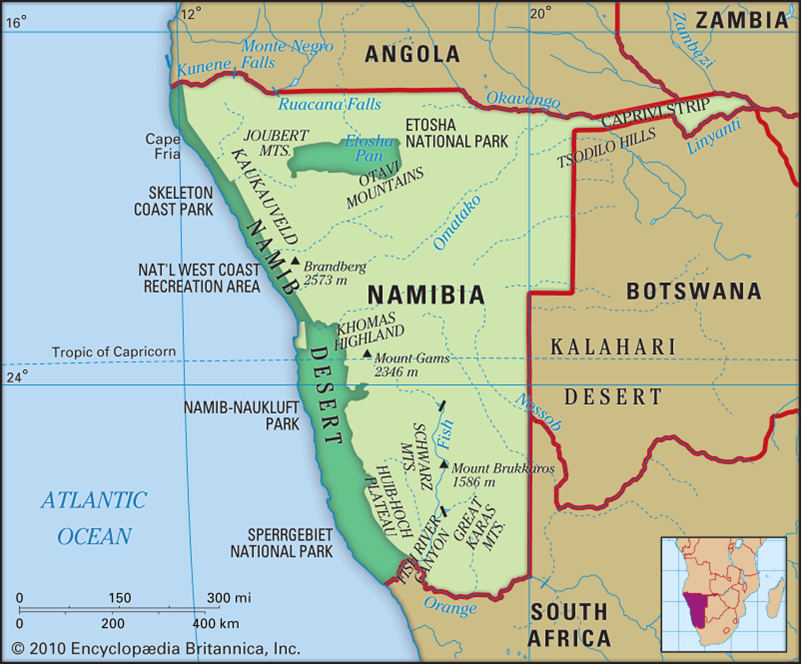
- Situated in southern Africa, along the southwestern coast of the continent.
- Borders:
- North: Angola
- Northeast: Zambia and a small section along the Zambezi River
- East: Botswana
- South and Southeast: South Africa
- West: Atlantic Ocean
- Capital City: Windhoek, located in the central highlands.
- Major Physical Features:
- Namib Desert: Runs along the entire Atlantic coast; one of the oldest deserts in the world.
- Kalahari Desert: Lies in the east; more vegetated than the Namib.
- Etosha Pan: A large salt pan in Etosha National Park, a key wildlife area.
- Skeleton Coast: Known for shipwrecks, fog, and desert wildlife.
- Caprivi Strip: A narrow, lush, tropical region in the northeast with rivers like the Okavango and Zambezi.
- Climate: Mostly arid to semi-arid; dry with hot summers and mild winters.
- Population: One of the lowest population densities in the world due to vast deserts.
- Ethnic Groups: Predominantly Ovambo, along with Herero, Himba, and others.
- Natural Resources: Rich in diamonds, uranium, copper, and other minerals.
- Independence: Gained from South Africa in 1990.
- Political System: Stable democracy with regular elections.
- Economy:
- Based on mining, tourism, agriculture, and fishing.
- Tourism is growing rapidly due to unique landscapes and wildlife.
- Languages: English is the official language, with many indigenous languages also spoken.
- Unique Features:
- Home to desert-adapted elephants and lions.
- One of the few places where the desert meets the ocean.
Panna Tiger Reserve / Panna National Park
Why in the News?
- Panna Tiger Reserve is in the news due to the death of Vatsala, a female elephant believed to be over 100 years old, making her one of the oldest elephants in Asia.
- She passed away on 8th July 2025 due to age-related complications.
What are the Key Highlights?
Ecological Features:
| Parameter | Details |
| Name | Panna Tiger Reserve |
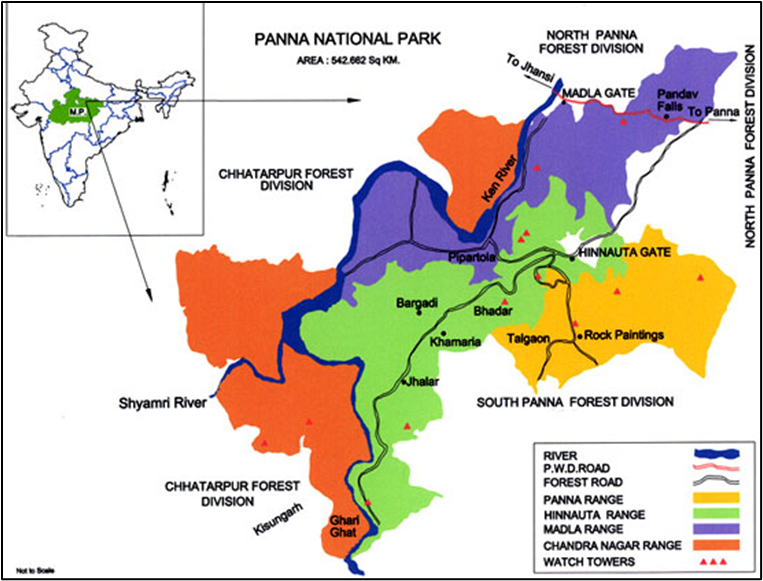
| Location | Madhya Pradesh (Panna & Chhatarpur districts) |
| Latitude & Longitude | 24.27°N – 24.59°N, 79.45°E – 80.09°E |
| State | Madhya Pradesh |
| Year of Establishment as TR | 1994 (under Project Tiger) |
| Area (Core) | 576.13 sq. km |
| Area (Buffer) | 1,021.97 sq. km |
| Total Area | ~1,598 sq. km |
| Biogeographic Zone | Deccan Peninsula (Central Highlands) |
| Main River | Ken River (tributary of Yamuna) flowing north to south |
| UNESCO Recognition | Declared a Biosphere Reserve in 2011 |
| Eco-Sensitive Zone Notification | Notified in 2017, covering ~750 sq. km outside reserve boundary |
| Nearest Towns | Panna, Khajuraho |
| Nearest Airport | Khajuraho Airport (~25 km away) |
| Nearest Railway Stations | Khajuraho, Satna |
- Type of Forests: Tropical dry deciduous forests; part of the Khathiar-Gir dry deciduous ecoregion
- Flora: Teak, Kardhai, Salai, Mahua, Tendu, Amla, Bamboo, etc.
- Fauna:
- Apex predator: Royal Bengal Tiger
- Others: Leopard, Chinkara, Sambar, Nilgai, Wild boar, Sloth bear, Indian wolf, Hyena
- Birds: Over 200 species, including bar-headed geese and Indian vulture
- Protected under: Project Tiger, since 1994
- Zonation and Connectivity
- Core Area: 576.13 sq. km
- Buffer Area: 1,021.97 sq. km
- Connectivity: Forms part of the Ken-Betwa river corridor, crucial for wildlife migration between Panna, Bandhavgarh, and Sanjay-Dubri Tiger Reserves.
- Notable Aspects:
- Tiger Reintroduction Success: Panna had no tigers in 2009, but due to active relocation and protection, the population has rebounded to 40+ tigers.
- Ken-Betwa River Linking Project will impact parts of the reserve’s core area, raising conservation concerns.
- Ecotourism and community-based conservation models involve Baiga and Gond tribes.