Context
A recent scientific study has revealed that Cacti may develop new species much faster than earlier believed, despite their slow growth in desert environments.
About Cacti
- Cacti are desert-adapted succulent plants mainly native to the dry and semi-arid regions of North and South America.
- Nearly 2,000 species grouped under about 139 genera are known, displaying wide variation in size and form.
- Their stems are thick and fleshy because they function as water-storage structures during long dry periods.
- Most cacti possess spines instead of normal leaves, which help conserve moisture and protect the plant from herbivores.
- A waxy outer coating on the stem further reduces water loss through evaporation.
- These plants usually develop shallow but highly efficient roots that absorb rainwater rapidly.
Structural Adaptations
- Many cacti have a cylindrical or column-like body shape that reduces exposed surface area and limits moisture loss.
- Vertical ridges on the stem allow expansion after water absorption during rainfall.
- Cacti are distinguished from other succulents by the presence of areoles, which are specialized cushion-like structures.
Special Features
- Areoles may produce flowers, spines, branches, hairs, or leaves depending on the species.
- Tiny barbed bristles called glochids are commonly found in some species, especially prickly pears.
- Hair-like structures known as trichomes help provide protection and reduce water loss.
Major Types
- Opuntias (Prickly Pear Cacti)
- Characterized by flat, pad-like stems instead of cylindrical ones.
- These cacti bear edible fruits and are densely covered with spines.
- Columnar Cacti
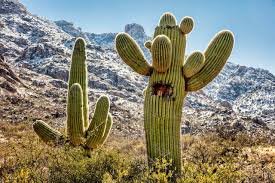
- Possess tall upright stems with prominent vertical ribs.
- Many large species serve as shelter and nesting sites for desert animals.