Context
Recent reports suggest that Hezbollah is using fiber optic drones against Israel
About Fiber Optic Drones
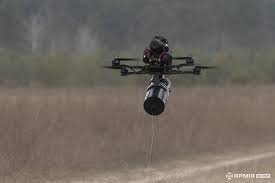
Fiber optic drones are unmanned aerial vehicles (UAVs) that use fiber optic technology for communication and control instead of standard wireless systems.
Key Features and advantages
- Strong signal security: Communication through optical fiber makes it very difficult to jam, intercept, or disrupt data transmission.
- Low delay in communication: These drones provide almost instant (near-zero latency) data transfer, which is useful for real-time monitoring and targeting.
- Stable and high-speed connection: Fiber optic cables allow large amounts of data to be transmitted quickly and reliably over long distances.
- Effective in difficult environments: They can function well in areas where GPS signals are weak or radio frequencies are blocked, such as electronic warfare zones.
How they work
- These drones remain physically connected to a ground station through a thin fiber optic cable (tether).
- The cable carries control signals and sends back live video and data to the operator.
- In many cases, the tether can also supply power, reducing dependence on onboard batteries.
Applications
- Defense and warfare: Used for surveillance, reconnaissance, and precision operations in conflict zones.
- Infrastructure and telecom work: Helpful in inspecting networks, cables, and critical infrastructure.
- Disaster management: Useful in search, rescue, and monitoring operations during emergencies.