Context
Indian vultures recently came into focus after two birds released from the Melghat Tiger Reserve in Maharashtra were later spotted near Bhopal in Madhya Pradesh, covering a distance of over 1,000 km during their movement.
About Indian Vultures
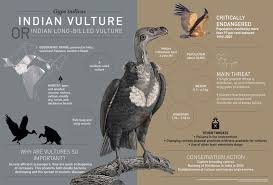
- The Indian vulture (Gyps indicus), commonly known as the long-billed vulture, is a scavenging bird species native to South Asia.
- It belongs to the Accipitridae family, which also includes birds such as eagles, kites and hawks, and is classified among the “Old World vultures.”
- The species is mainly distributed across India, Nepal and Pakistan, where it inhabits open landscapes, grasslands and areas close to human settlements and agricultural fields.
- Indian vultures are medium-sized but heavily built birds with broad wings that help them glide over long distances while conserving energy.
- Their body is generally light brown, while the head and long neck remain mostly featherless. They also possess a dark eye and a pale yellow beak.
- Females are comparatively smaller in size than males.
- The species witnessed a catastrophic population decline of nearly 97–99% due to the veterinary drug diclofenac.
- Diclofenac was widely administered to cattle for pain relief, but vultures suffered poisoning after feeding on carcasses of treated animals, leading to fatal kidney failure.
- Owing to this sharp decline, the Indian vulture has been listed as “Critically Endangered” by the IUCN Red List.
Melghat Tiger Reserve
- Melghat Tiger Reserve is situated in the Amravati district of Maharashtra and was the first tiger reserve established in the State.
- The reserve lies in the Gavilgarh Hills, which form the southern extension of the Satpura Range. The term “Melghat” literally means “meeting of the ghats.”
- The Tapti River flows along its northeastern boundary, while rivers such as Sipna, Gadga, Khapra, Dolar and Khandu flow through the reserve area.
- Tropical dry deciduous forests dominate the landscape, with teak being the most prominent tree species. Other important vegetation includes bamboo, Ain and Haldu.
- The reserve supports rich wildlife diversity, including leopard, sloth bear, Indian gaur, sambar, nilgai, hyena, dhole and jungle cat.
- Melghat is also recognised as an important habitat of the critically endangered forest owlet.
- The Korku tribe forms the major tribal community residing in and around the reserve region.