Important questions for UPSC Pre/ Mains/ Interview:
|
Context
The recent synchronised survey initiated by Tamil Nadu Forest Department to estimate the population of the Nilgiri Tahr highlights ongoing efforts to conserve endemic biodiversity in the Western Ghats.
Q1. What is the Nilgiri Tahr and where is it found?
- A mountain ungulate endemic to southern India. Only such species found in the region.
- Geographical distribution: Confined to the Western Ghats across Tamil Nadu and Kerala. Spread across a ~400 km stretch.
- Key habitat: Montane grasslands interspersed with ‘shola’ forests. Altitude range: 1200–2600 metres.
- Important population centre: Eravikulam National Park holds the largest population.
Q2. Why is the Nilgiri Tahr important ecologically?
- Indicator species: Reflects the health of high-altitude grassland ecosystems.
- Endemism: Found nowhere else in the world, making conservation critical.
- Ecosystem role: Grazing helps maintain grassland dynamics. Supports predator-prey balance.
- Biodiversity significance: Part of the Western Ghats, a global biodiversity hotspot.
Q3. What are the key features of the Nilgiri Tahr?
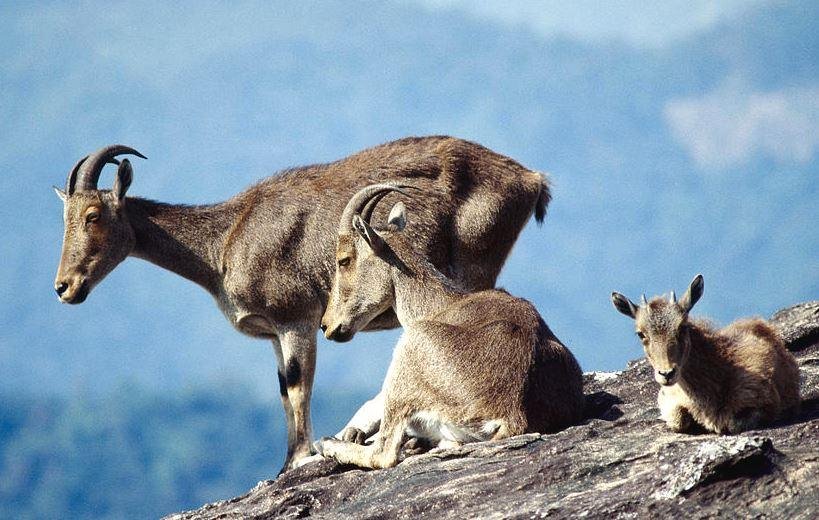
- Physical characteristics: Stocky build with coarse fur and bristly mane. Both sexes have curved horns.
- Sexual dimorphism: Males are larger and darker in colour. Females are smaller and lighter.
- Adaptations: Strong limbs for navigating steep rocky terrain. Ability to survive in high-altitude climates.
Q4. What is the conservation status and legal protection of the species?
- Global status: Classified as Endangered under IUCN Red List.
- National protection: Listed under Schedule I of the Wildlife (Protection) Act, 1972. Receives highest level of legal protection in India.
- Policy significance: Priority species for conservation programmes in southern India.
Q5. What are the major threats faced by the Nilgiri Tahr?
- Habitat loss: Deforestation and conversion to plantations.
- Developmental pressures: Hydroelectric projects in mountain ecosystems.
- Competition: Grazing pressure from domestic livestock.
- Fragmentation: Isolation of populations reduces genetic diversity.
- Climate factors: Changes in temperature and rainfall patterns affecting habitat.
Q6. Why are synchronised surveys important for conservation?
- Accurate population estimation: Simultaneous counting reduces duplication and errors.
- Scientific management: Helps track population trends over time.
- Policy planning: Provides data for habitat protection and restoration.
- Inter-state coordination: Essential as species range spans multiple states.
Q7. What measures and safeguards are required for its conservation?
- Habitat protection: Conservation of montane grasslands and shola ecosystems.
- Regulation of development: Environmental impact assessments for projects in sensitive areas.
- Community involvement: Engage local communities in conservation efforts.
- Scientific interventions: Regular monitoring and research on population genetics.
- Policy and enforcement: Strict implementation of wildlife protection laws.
Conclusion
The conservation of the Nilgiri Tahr reflects the broader challenge of protecting endemic species in fragile ecosystems. While initiatives like synchronised surveys strengthen scientific management, long-term success depends on safeguarding habitats and balancing development with ecological sustainability.