Important questions for UPSC Pre/ Mains/ Interview:
|
Context
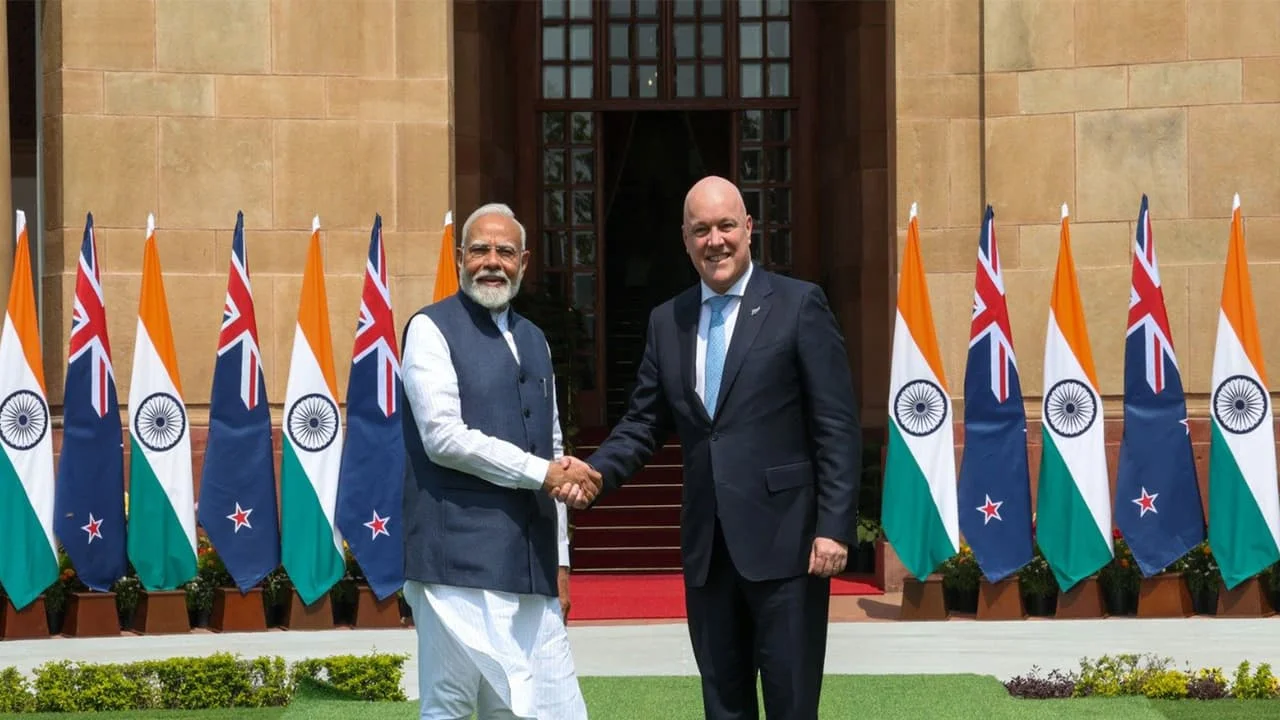
India and New Zealand have signed a comprehensive Free Trade Agreement (FTA), marking a significant step in expanding trade, investment, and strategic cooperation.
Q1. What is a Free Trade Agreement (FTA), and how does it facilitate international trade and economic integration?
- A Free Trade Agreement (FTA) is a formal arrangement between countries to reduce or eliminate tariffs, quotas, and other trade barriers.
- Its primary objective is to promote smoother trade flows, enhance investment opportunities, and deepen economic integration between participating countries.
- By improving market access and reducing costs, FTAs enable businesses to expand exports and strengthen global economic linkages.
Q2. What are the key features of the India-New Zealand Free Trade Agreement in terms of tariff liberalisation and market access?
- The agreement provides duty-free or preferential access for a wide range of Indian exports to New Zealand.
- Key sectors such as textiles, pharmaceuticals, engineering goods, and agricultural products are expected to benefit significantly.
- This improved access enhances the competitiveness of Indian goods in a developed market and creates new export opportunities.
- Overall, tariff liberalisation under the FTA strengthens India’s trade presence in the region.
Q3. How do the investment commitments under the India-New Zealand FTA contribute to India’s economic growth?
- New Zealand has committed substantial investments in India across sectors such as infrastructure, renewable energy, food processing, and technology.
- These investments increase capital availability, support industrial expansion, and accelerate economic development.
- They also promote technology transfer and innovation, which are crucial for long-term growth.
- Thus, investment commitments under the FTA act as a catalyst for India’s economic transformation.
Q4. What opportunities does the India-New Zealand FTA create for India’s services sector and skilled workforce?
- The agreement facilitates easier movement of professionals and service providers between the two countries.
- Indian IT professionals, healthcare workers, and education service providers are expected to gain improved access to New Zealand’s market.
- This aligns with India’s strength in services exports and enhances global employment opportunities for its skilled workforce.
- It also contributes to increasing India’s share in global services trade.
Q5. How does the India-New Zealand FTA address concerns related to agricultural trade and domestic sensitivities?
- Agriculture, especially dairy, is a sensitive sector due to New Zealand’s strong export capabilities.
- The agreement is expected to include safeguards and phased or limited market access to protect Indian farmers.
- This ensures that domestic interests are not adversely affected while still allowing controlled liberalisation.
- Balancing trade openness with protection of vulnerable sectors is a key feature of the FTA.
Q6. What is the strategic and geopolitical significance of the India-New Zealand FTA in the Indo-Pacific region?
- The FTA strengthens India’s economic engagement in the Indo-Pacific region and diversifies its trade partnerships.
- It reflects India’s renewed focus on bilateral trade agreements after opting out of broader regional arrangements.
- The agreement enhances India’s strategic presence and cooperation with like-minded economies in the region.
- Thus, it has both economic and geopolitical importance.
Q7. What challenges must India address to effectively utilise the benefits of the India-New Zealand FTA?
- Domestic industries, particularly agriculture, may face increased competition and require adjustment support.
- Ensuring that exporters fully utilise market access opportunities remains a challenge, as seen in previous FTAs.
- Strengthening regulatory compliance, improving infrastructure, and enhancing competitiveness are essential for maximising gains.
- Addressing these challenges will determine the long-term success of the agreement.
Conclusion
The India-New Zealand FTA represents a major step in boosting trade, investment, and strategic ties. Its success will depend on balancing domestic interests with effective utilisation of new opportunities.