Important questions for UPSC Pre/ Mains/ Interview:
|
Context
A recent study shows that rising sea surface temperatures are increasing humid heatwaves over land, with Rossby waves trapping heat and moisture, leading to dangerous rises in wet-bulb temperature.
Q1. What are Rossby Waves and how are they formed?
- Rossby waves are large-scale atmospheric and oceanic waves that appear as giant bends or meanders in air and water flow.
- They are formed mainly due to Earth’s rotation (Coriolis force) and temperature differences between land and ocean or equator and poles.
- In the atmosphere, they are closely linked to the jet stream & influence global weather patterns.
- These waves help in redistributing heat, moving warm air towards poles and cold air towards lower latitudes.
- When these waves slow down or become stationary, they can lead to prolonged weather conditions like heatwaves or heavy rainfall.
Q2. What are the different types of Rossby Waves?
- Oceanic Rossby Waves: Occur in oceans & move slowly along thermocline (boundary between warm & cold water). Influence sea level changes, ocean circulation, & climate patterns.
- Atmospheric Rossby Waves: Found in the upper atmosphere as large loops in high-altitude winds. Control movement of cyclones, anticyclones, and weather systems.
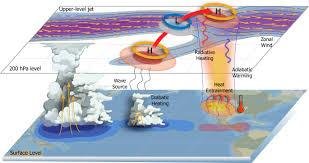
- Poleward Propagating (Topographic) Rossby Waves: Generated due to intense heating in tropical regions. Travel towards higher latitudes and influence distant weather patterns. Can be modified by mountains and landforms.
Q3. What is Wet-bulb Temperature and how is it measured?
- It is the lowest temperature air can reach via evaporation of water at constant pressure.
- It is measured using a thermometer covered with a wet cloth, where evaporation cools the bulb. It reflects the combined effect of temperature and humidity, unlike normal (dry-bulb) temperature.
- At 100% humidity, wet-bulb and dry-bulb temperatures are equal because no evaporation occurs. At lower humidity, the wet-bulb temperature is lower due to cooling by evaporation.
Q4. Why is Wet-bulb Temperature important for human survival?
- Wet-bulb temperature determines the body’s ability to cool itself through sweating.
- When it rises above ~31.5°C, the human body cannot effectively lose heat, leading to serious health risks.
- The internationally accepted danger threshold is around 35°C, beyond which survival becomes difficult even for healthy individuals.
- Exposure to high wet-bulb temperatures can cause:
- Heat stress and hyperthermia
- Organ damage (brain, heart)
- Increased risk of death in extreme cases
- It is a better indicator of heatwave severity than temperature alone.
Q5. How do Rossby Waves contribute to humid heatwaves?
- Rossby waves can sometimes become slow-moving or stationary (stalled).
- When stalled, they trap hot and moisture-laden air over a region for long periods.
- Coastal warming increases sea surface temperatures, adding more moisture to the air.
- This combination leads to humid heatwaves, where both temperature & humidity rise together.
- Increased humidity raises the wet-bulb temperature, making heatwaves more dangerous.
Q6. What is the significance of this study on Rossby Waves and Wet-bulb Temperature?
- It highlights the growing link between climate change, ocean warming, & extreme heat events.
- It shows that humid heatwaves are increasing (50–64%), especially in coastal regions.
- It emphasizes that heat risk depends on humidity, not just temperature.
- It points out gaps in current systems, as wet-bulb temperature is not fully included in IMD heatwave definitions.
- It provides an early warning for India, where dense populations are highly vulnerable to such conditions.
Conclusion
The study shows that future heatwaves will be more dangerous due to combined heat and humidity, making it essential to shift from temperature-based understanding to wet-bulb based risk assessment.