Important questions for UPSC Pre/ Mains/ Interview:
|
Context
A recent study along Chennai coast reveals that although microplastics occur in smaller quantities, their type, nylon fibres, makes them highly dangerous, showing that low quantity does not mean low risk.
Q1. What are Microplastics?
- Microplastics are tiny plastic particles smaller than 5 mm in size.
- They are formed either by breakdown of larger plastic waste or are directly released as small particles.
- Major sources: Synthetic clothing fibres, fishing nets, plastic debris, and industrial products.
- They exist in different forms such as fibres, fragments, pellets, and films. Among these, fibres (especially nylon) are particularly harmful due to their structure and persistence.
Q2. Why does low abundance of microplastics not necessarily imply low ecological risk?
- The Chennai study shows that risk depends on characteristics, not just quantity.
- Even with fewer microplastics, nylon fibres dominate, which are more toxic and persistent.
- Most particles are very small (<1000 µm), making them easy to ingest by marine organisms.
- There is a shift from quantity-based assessment to risk-based assessment.
- Key Factors Determining Risk:
- Polymer type (nylon): More chemically harmful and long-lasting.
- Shape (fibres): Easily ingested and can cause physical damage.
- Size (very small): Quickly enters biological systems and food chains.
- Chemical nature: Absorbs toxins like heavy metals, increasing toxicity.
Q3. What are the ecological risks posed by microplastics in coastal and marine ecosystems?
- Impact on Marine Organisms: Small organisms like worms, crabs, and shellfish ingest fibres, which block their digestive system. This causes internal injuries, reduced feeding, and toxicity.
- Entry into Food Chain: Microplastics move from plankton → fish → birds → humans. This leads to bioaccumulation (build-up in organisms) & biomagnification (increase along the food chain).
- Chemical Toxicity: Plastics contain harmful additives and absorb pollutants like heavy metals. This results in poisoning of marine organisms.
- Habitat Alteration: Fibre-shaped plastics change sediment structure. They disturb benthic ecosystems (sea-bottom life) and microbial balance.
- Long-Term & Global Impact: Microplastics are persistent and travel long distances, making pollution a global issue rather than local.
Q4. What are the potential human health risks associated with microplastic exposure?
- Microplastics enter humans through seafood, drinking water, and air.
- Possible health effects include tissue inflammation, hormonal disruption and immune system damage.
- Although research is ongoing, evidence of risks is steadily increasing.
Q5. What are the major sources & pathways of microplastic pollution along Chennai coast?
- Fishing activities: Degradation of nets and ropes releases fibres.
- Synthetic clothing: Washing clothes releases microfibres into wastewater.
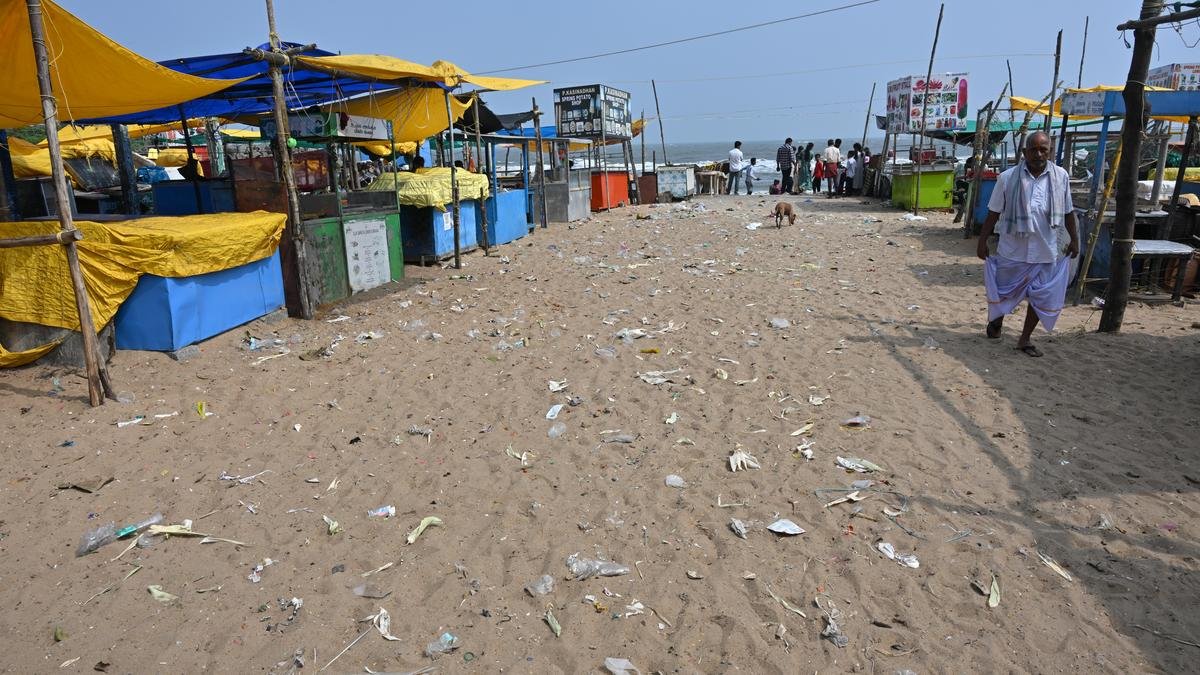
- Tourism: Plastic litter on beaches breaks down into microplastics.
- Urban sewage: Carries plastic particles into the sea.
- Stormwater drains: Directly transport waste to coastal areas.
Q6. Why is Chennai microplastic study significant for environmental policy & assessment frameworks?
- It acts as an early warning signal, as pollution is still at a developing stage.
- It fills a data gap for tropical coastal cities, especially in India.
- It shows that traditional metrics (counting plastics) are misleading.
- It highlights the need for multi-dimensional risk assessment (type, size, toxicity).
Q7. What are the implications of microplastic pollution along the Chennai coast?
- Environmental: Threat to coastal biodiversity and ecosystem balance.
- Economic: Impacts fisheries and tourism-dependent livelihoods.
- Public Health: Increased human exposure through contaminated food and water.
Q8. What are the challenges associated with microplastic pollution and what measures can be taken to address them?
| Challenges | Way Forward |
| 1. Microplastics are invisible and difficult to detect | Use advanced monitoring focusing on size, type, and toxicity |
| 2. Poor waste management systems | Strengthen waste segregation, recycling, and disposal |
| 3. Pollution from fishing gear | Promote biodegradable and recyclable fishing materials |
| 4. Urban runoff carrying plastics to sea | Improve sewage treatment and stormwater systems |
| 5. Lack of public awareness | Conduct behavioural change and awareness campaigns |
| 6. Policy gaps in coastal regulation | Implement stricter and targeted coastal pollution laws |
Conclusion
The Chennai case highlights that environmental damage depends not just on quantity but the nature of pollutants, making early intervention crucial to prevent long-term ecological and health impacts.