Important questions for UPSC Pre/ Mains/ Interview:
|
Context
Delhi government & IIT Madras are studying “smog-eating” photocatalytic coatings to address urban air pollution, reflecting growing efforts to adopt technology-based solutions for air quality management.
Q1. What is Smog-Eating Photocatalytic Coating?
- A surface coating applied on roads/buildings to reduce air pollution (passive pollution control mechanism) which converts pollutants into less harmful substances.
- Designed to neutralise harmful pollutants like nitrogen oxides (NOx) and volatile organic compounds (VOCs).
Q2. How does Photocatalytic Coating work?
- Uses light energy (sunlight/UV rays) to activate chemical reactions
- Core process: Photocatalyst absorbs light to generate reactive species (free radicals) and break down pollutants into harmless compounds
- Outcomes: Reduction in NO₂ and hydrocarbons, cleaner surrounding air and potential self-cleaning surfaces.
Q3. Why is Titanium Dioxide (TiO₂) used?
- It uses titanium dioxide as a coating because it is low cost and widely available.
- It is also chemically stable and non-toxic.
- It is compatible with concrete, asphalt and building materials.
- It has proven effectiveness in gaseous de-pollution & is applied in environmental cleaning technologies.
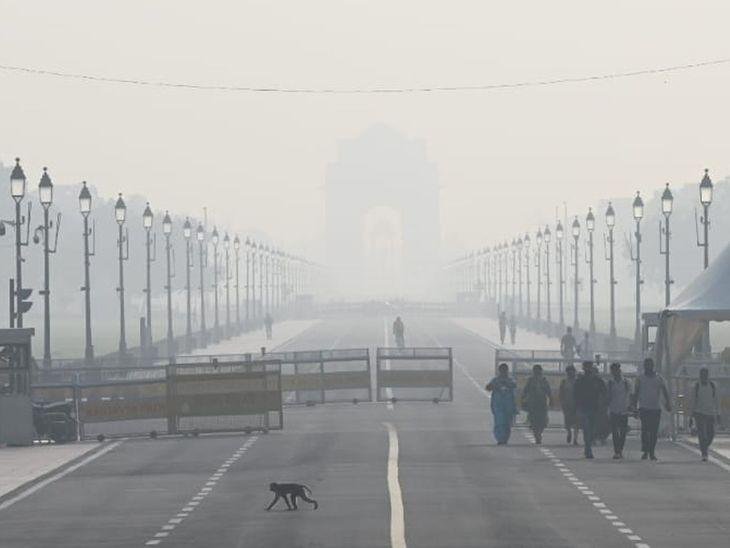
Q4. What is Smog and how is it classified?
- Smog = mixture of smoke + fog + pollutants
- Formed due to interaction of emissions with atmospheric conditions
- Types of Smog
- Sulfurous Smog: Caused by burning coal (sulfur oxides). Common in industrial regions.
- Photochemical Smog: Caused by vehicle emissions + sunlight. Dominant in urban areas. Produces ozone, NOx, and secondary pollutants.
Q5. What are the advantages of this technology?
- Environmental Benefits: Reduces urban air pollutants, improving air quality and supporting climate and clean air goals.
- Administrative Benefits: Can be integrated into existing infrastructure and is low maintenance once applied.
- Technological Benefits: Passive system (no continuous energy input needed beyond sunlight) and scalable across roads, pavements, buildings.
Q6. What are the challenges and limitations?
- Effectiveness Constraints: Works best under strong sunlight, so limited impact at large city scale.
- Environmental Concerns: By-products (like nitrates) may accumulate. Requires monitoring of secondary impacts.
- Economic & Implementation Issues: Initial application cost and need for large-scale deployment for meaningful impact.
- Scientific Uncertainty: Mixed results in real-world urban conditions. Effectiveness varies with pollution levels and climate.
Q7. What is the significance for urban governance?
- Represents technology-driven urban environmental management.
- Complements existing measures like emission control, EV adoption & public transport expansion.
- Supports Smart city initiatives and sustainable urban planning.
Conclusion
Smog-eating photocatalytic coatings offer an innovative, technology-based tool for tackling urban air pollution. However, they are not a standalone solution and must complement broader strategies like emission reduction and policy reforms to achieve sustainable air quality improvement.