Context
The government plans to include AgriPV (Agrivoltaics) under PM KUSUM Scheme 2.0, aiming to enhance farmer income and expand clean energy use in agriculture.
Q1. What is AgriPV (Agrivoltaics)?
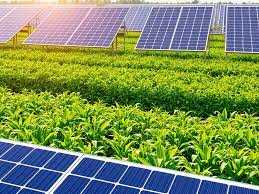
- AgriPV (Agrivoltaics) refers to the simultaneous use of land for agriculture and solar power generation.
- Solar panels are installed between crop rows, or elevated above crops.
- It does not replace farming, but adds an additional layer of income through energy generation.
Q2. What is the PM KUSUM Scheme and its link with AgriPV?
- The scheme was launched in 2019 to promote solar irrigation pumps, reduce diesel dependence and increase farmer income.
- It provides up to 60% subsidy.
- Under KUSUM 2.0, the scope is being expanded to include AgriPV systems, integrating farming with solar energy.
Q3. Why is AgriPV needed?
- Land constraint: Solar projects need large land, while India has fragmented landholdings → AgriPV resolves the energy vs agriculture conflict.
- Decarbonisation: Reduces dependence on diesel pumps, lowering emissions.
- Income diversification: Farmers can use electricity for irrigation and sell surplus power.
Q4. Which crops are suitable for AgriPV?
- Suitability depends on climate, soil conditions and sunlight intensity.
- Madhya Pradesh: Tomato, onion, garlic, turmeric.
- Karnataka & Maharashtra (semi-arid): Ragi, jowar, chilli, banana.
Q5. How does AgriPV work?
- Crops are cultivated in rows, with solar panels installed between rows, or on raised structures above crops.
- Types include:
- Vertical panels
- Tracking panels (move with sunlight)
- Greenhouse-integrated systems
Q6. What are the benefits of AgriPV?
- Economic Benefits: Additional and stable income from electricity and reduced input cost (diesel replaced by solar).
- Environmental Benefits: Lower greenhouse gas emissions which also supports clean energy transition.
- Agricultural Benefits: Provides shade, reducing heat stress and protecting crops from excess rain, hail, and frost. This improves crop resilience.
- Energy Security: Increases renewable energy capacity and reduces dependence on fossil fuels and imports.
Q7. What are the challenges and way forward?
| Challenges | Way Forward |
| High initial investment cost | Provide targeted subsidies under KUSUM 2.0 |
| Lack of awareness among farmers | Strengthen training, awareness campaigns, and extension services |
| Crop compatibility issues | Promote region-specific research and crop advisories |
| Small and fragmented landholdings | Encourage Farmer Producer Organisations (FPOs) and cooperative models |
| Technical complexity in installation and maintenance | Involve research institutions and agricultural universities |
| Risk of excessive corporate control | Regulate land leasing and ensure farmer safeguards |
| Policy and regulatory gaps | Develop clear guidelines and implementation frameworks |
Conclusion
AgriPV offers a win-win solution by combining energy generation with agriculture, helping India achieve farmer income growth, energy security, and sustainable development simultaneously.