Important questions for UPSC Pre/ Mains/ Interview:
|
Context
Recent analyses of electoral data show that women in India now vote at nearly the same rate as men. However, despite this progress in electoral participation, women remain significantly underrepresented in legislatures and political campaigns.
Q1. How has women’s participation as voters evolved in India?
- In the decades after Independence, women voted at significantly lower rates than men.
- In the 1967 Lok Sabha election, male turnout was 66.7%, while female turnout was 55.5%, creating a gap of over 11 percentage points.
- The disparity was largely due to lower female literacy levels, domestic responsibilities, limited outreach by political parties, restricted mobility and social norms.
- From the 1980s onward, the gender gap in voter turnout gradually declined.
- By 2009, the gap reduced to about 4.4 percentage points.
- In 2014, the gap narrowed further to around 1.5 percentage points.
- By the 2019 and 2024 Lok Sabha elections, women voted at nearly the same rate as men, marking a major shift in India’s electoral participation patterns.
Q2. What trends are visible in women’s participation in State Assembly elections?
- In the early 1990s, women’s turnout in State elections was typically 4–5 percentage points lower than men’s.
- The gap narrowed significantly during the 2000s.
- After 2011, several states began recording higher turnout among women than men.
- Between 2015 and 2016, women’s turnout exceeded men’s by about 2.8 percentage points in many State elections.
- During the 2020–2025 period, women continued to vote at slightly higher rates than men in several states.
This indicates that women have become an increasingly influential electoral constituency.
Q3. How active are women in political campaigning and electoral activities?
- Despite higher voter turnout, women’s participation in campaign-related activities remains limited.
- Across Lok Sabha elections between 2009 and 2024, men consistently reported higher engagement in activities such as attending rallies, participating in processions and door-to-door campaigning.
- Women attending rallies increased from about 9% in 2009 to around 16% in recent elections.
- Participation in campaign processions and canvassing rose from 5–6% to around 11%.
- However, men’s participation remains roughly double that of women.
- A key constraint is family approval, as many women require permission from family members to attend political gatherings.
Q4. What is the current level of women’s representation in Parliament?
- Women have historically been underrepresented in India’s legislatures.
- In the first Lok Sabha (1952), only 22 women were elected.
- The number increased gradually in the 21st century:
- 59 women MPs in 2009
- 62 women MPs in 2014
- 78 women MPs in 2019 (highest ever)
- 74 women MPs in 2024
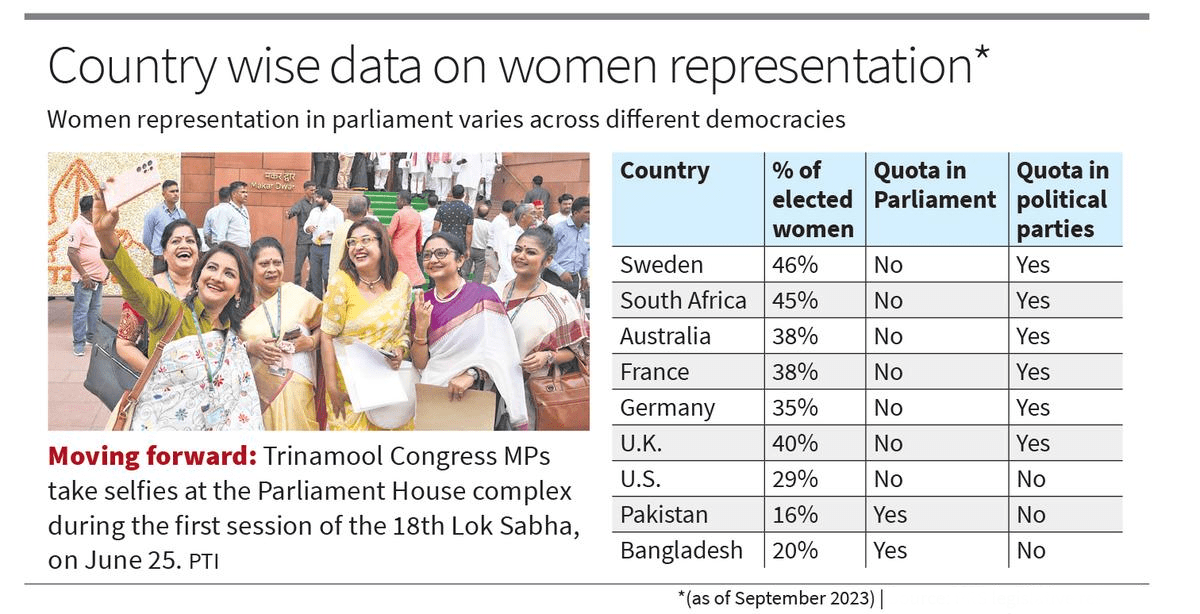
- Even at its peak, women represented only about 14% of the Lok Sabha, far below their nearly 50% share in the electorate.
Q5. Why do fewer women contest elections despite high voter participation?
- The number of women contesting elections has increased but remains relatively small.
- Examples:
- 1957: Around 45 women candidates.
- 2014: Around 668 women candidates.
- 2019: Around 726 women candidates.
- 2024: Around 800 women candidates.
- However, thousands of male candidates contest elections.
- Interestingly, evidence shows that women candidates often perform as well as or better than men:
| Election Year | Women’s Success Rate | Men’s Success Rate |
| 2019 | ~11% | ~6% |
| 2024 | ~9% | ~6% |
- This indicates that the main barrier is candidate nomination rather than electoral success.
Q6. What structural barriers limit women’s political representation?
- Several social and institutional factors restrict women’s participation in politics.
- Survey findings highlight key perceptions:
- 58% of respondents believe political families have easier access to politics.
- 57% believe wealthier women have better chances of entering politics.
- 44% believe political parties prefer men when distributing tickets.
- Broader barriers include:
- Patriarchal social norms
- Heavy household responsibilities
- Limited political networks and experience
- Financial and cultural constraints
- These structural barriers reduce women’s ability to enter and sustain political careers.
Q7. What reforms can strengthen women’s political representation?
- The Women’s Reservation Bill (Nari Shakti Vandan Adhiniyam) proposes 33% reservation for women in Lok Sabha and State Assemblies.
- Political parties can increase representation by allocating more tickets to women candidates and promoting women leaders within party organisations.
- Capacity-building initiatives can support leadership training & political awareness among women.
- Social reforms addressing gender inequality and mobility restrictions are also necessary.
Conclusion
Women’s voter participation in India has reached near parity with men, reflecting major progress in democratic inclusion. However, their representation in legislatures and active political roles remains limited due to structural and institutional barriers. Strengthening candidate nomination, implementing reservation policies, and promoting gender-inclusive political institutions will be essential to translate electoral participation into meaningful political representation.