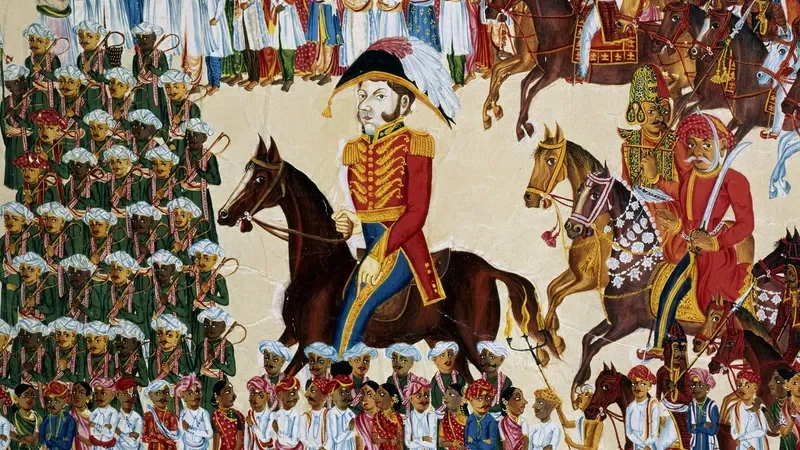
The Doctrine of Lapse was a pivotal imperialist policy implemented by the British East India Company in the mid-19th century. Primarily executed under the administration of Lord Dalhousie (Governor-General of India from 1848 to 1856), this policy became a potent tool for the aggressive expansion of British territories. By challenging traditional Indian customs of succession, the doctrine systematically annexed princely states that lacked a direct natural male heir.
While the British justified the policy as a means to improve administrative efficiency and “good governance,” it was deeply resented by Indian royalty. This discontent became a primary catalyst for the Indian Rebellion of 1857, eventually forcing the British Crown to abandon the doctrine in favor of a more conciliatory approach toward the princely states.
Historical Background of the Doctrine
The Doctrine of Lapse arose from the East India Company’s need to consolidate power and increase revenue. Before the 1840s, it was common for Indian rulers without a direct male heir to adopt a son to ensure the continuity of their dynasty—a practice recognized by Hindu law and local customs.
1 Paramountcy Principle: The British claimed that as the “Paramount Power” in India, they had the supreme right to either recognize or reject the succession of adopted heirs.
2 Court of Directors: Although often associated solely with Dalhousie, the policy was officially introduced by the Court of Directors in 1847.
3 Economic Motivation: Annexations allowed the Company to directly tap into the revenue of wealthy states and reduce the financial burden of maintaining Subsidiary Alliances.
Key Features of the Doctrine of Lapse
The doctrine redefined the legal relationship between the British and the Indian states through several strict provisions:
1 Non-Recognition of Adopted Heirs: If a ruler of a dependent state died without a natural male heir, the state “lapsed” to the British. The company refused to recognize the traditional right of adoption for the purpose of political succession.
2 Limited Inheritance: An adopted son could inherit the late prince’s personal property and belongings, but he had no legal claim to the throne or the sovereignty of the kingdom.
3 Forfeiture of Titles and Pensions: Adopted heirs were barred from receiving the titles or pensions previously granted to their fathers by the British.
4 Mandatory British Consent: In cases where adoption was permitted, the doctrine mandated that the process must have explicit, prior approval from British authorities to be valid.
5 The Misgovernance Pretext: Beyond the lack of an heir, the British occasionally used “chronic misgovernance” as a secondary rationale to justify annexation, as seen in the case of Awadh.
Chronology of Annexed States
Under Lord Dalhousie, several prominent and strategically vital states were brought under direct British rule.
| Year | State | Reason for Annexation |
| 1848 | Satara | First state to be annexed; the Raja died without a natural heir. |
| 1849 | Jaitpur & Sambalpur | Annexed due to the lack of male successors. |
| 1850 | Baghat | Annexed after the ruler died without a direct heir. |
| 1852 | Udaipur | (In present-day Chhattisgarh) Annexed due to failure of natural succession. |
| 1853 | Jhansi | The British rejected the adoption of Damodar Rao by Gangadhar Rao. |
| 1854 | Nagpur | One of the largest and most revenue-rich annexations. |
| 1856 | Awadh (Oudh) | Annexed on the grounds of misgovernance rather than lack of an heir. |
Profound Effects and Consequences
The implementation of the Doctrine of Lapse significantly altered the course of Indian history:
1 Aggressive Territorial Expansion: The British successfully consolidated the map of India, creating a more continuous stretch of territory for administration and railway expansion.
2 Widespread Resentment: The policy alienated the Indian ruling class. Figures like Nana Sahib (denied his father’s pension) and Rani Lakshmibai became fierce enemies of the British.
3 Cultural Shock: By interfering with religious and traditional succession practices, the British were perceived as a threat to the Indian way of life.
4 The 1857 Uprising: The doctrine is widely considered a major “political cause” of the 1857 Rebellion. Many of the sepoys in the British army came from annexed regions like Awadh and were personally affected by the policy.
5 Policy Reversal: Following the 1857 Rebellion, the Government of India Act 1858 saw the British Crown take over from the Company. The Queen’s Proclamation explicitly abandoned the Doctrine of Lapse to win back the loyalty of the remaining princely states.
FAQs on the Doctrine of Lapse
WHO INTRODUCED THE DOCTRINE OF LAPSE?
The policy was most aggressively implemented by Lord Dalhousie, though it was officially introduced by the East India Company’s Court of Directors in 1847.
WHICH WAS THE FIRST STATE ANNEXED UNDER THIS DOCTRINE?
Satara was the first state to be annexed in 1848.
WHY WAS JHANSI ANNEXED?
Jhansi was annexed in 1853 because the British refused to recognize Damodar Rao, the adopted son of Maharaja Gangadhar Rao, as the legal heir to the throne.
COULD AN ADOPTED SON INHERIT ANYTHING?
Yes, under the doctrine, an adopted son could inherit the private property of the deceased ruler but not the kingdom or political titles.
WAS AWADH ANNEXED DUE TO THE DOCTRINE OF LAPSE?
Technically, no. Awadh was annexed in 1856 on the grounds of “chronic misgovernance,” although it followed the same imperialist spirit of Dalhousie’s other annexations.
WHO WAS NANA SAHIB AND HOW WAS HE AFFECTED?
Nana Sahib was the adopted son of Peshwa Baji Rao II. Under the Doctrine of Lapse, the British refused to continue his father’s pension, leading him to join the 1857 Rebellion.
WHAT WAS THE “PARAMOUNTCY” PRINCIPLE?
It was the British claim that as the supreme power in India, they had the right to decide on matters of succession in the states that were “dependent” on them.
WHEN WAS THE DOCTRINE OF LAPSE ABANDONED?
The policy was abandoned after the Indian Rebellion of 1857. The Queen’s Proclamation of 1858 assured Indian rulers that their right to adoption would be respected.
HOW DID THE DOCTRINE AFFECT THE 1857 REVOLT?
It was a major political cause. The rulers of annexed states and their displaced soldiers formed the core leadership of the rebellion in Central and North India.
WAS THE DOCTRINE BASED ON HINDU LAW?
The British claimed it was, but this was a misinterpretation. Hindu law fully supported the adoption of a son to continue both the family lineage and the rulership.