Important Questions for UPSC Prelims / Mains / Interview
|
Context
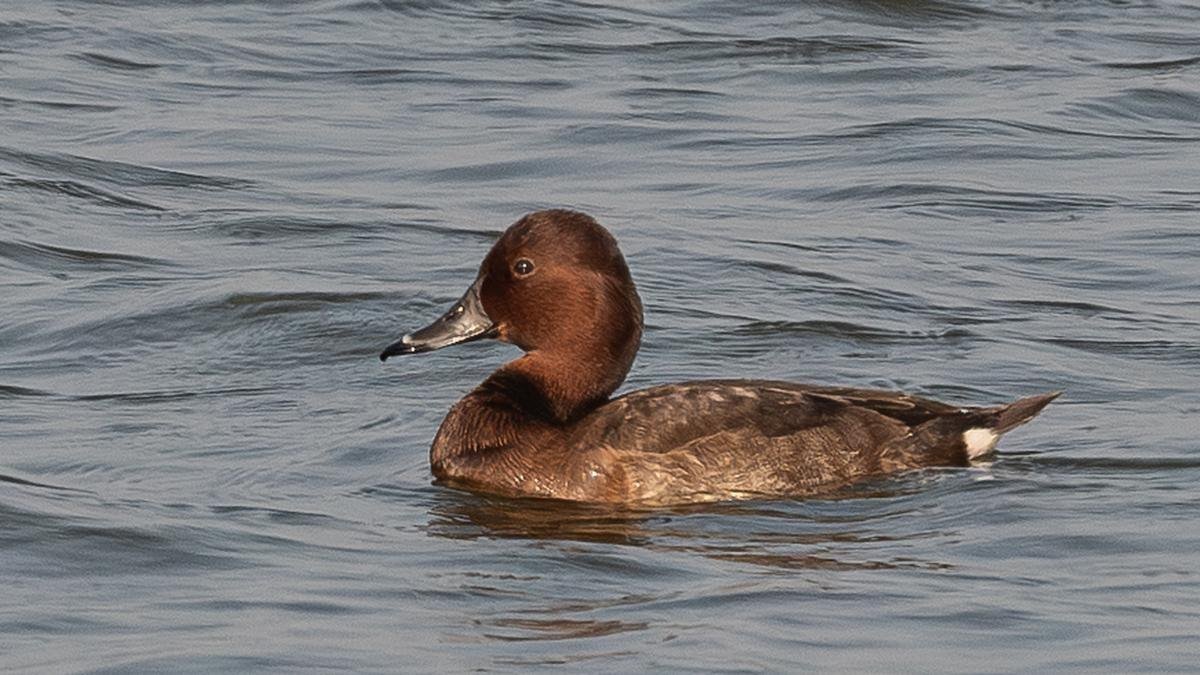
A lone Ferruginous Pochard was recently recorded among a flock of Common Pochards at Amoor Lake in Chennai.
Q1. What are the taxonomic features, physical characteristics, and habitat preferences of the Ferruginous Pochard?
- The Ferruginous Pochard (Aythya nyroca) is a medium-sized diving duck belonging to the family Anatidae.
- It is also known by alternative names such as ferruginous duck or white-eyed pochard due to its distinctive pale iris.
- Adult males are characterised by:
- Rich chestnut-brown plumage
- Prominent white eye
- White undertail patch
- Females are comparatively duller in colour, with brownish tones and less prominent eye contrast.
- As a diving duck, it feeds by submerging itself in water rather than dabbling at the surface.
- The species prefers shallow freshwater bodies with abundant submerged vegetation, floating plants and dense emergent vegetation along margins.
- Such habitats provide food availability and protection from predators.
- Its morphological adaptations, including strong legs placed towards the rear, support efficient diving.
Q2. What is the global distribution and migratory pattern of the Ferruginous Pochard, and why is its sighting in India significant?
- The Ferruginous Pochard is primarily distributed across parts of Europe, Central Asia, and western Asia.
- Its breeding range extends across Eurasian regions with suitable freshwater wetlands.
- During winter, populations migrate to:
- The Mediterranean Basin
- The Black Sea region
- Parts of sub-Saharan Africa via the Nile Valley
- Smaller populations disperse across parts of Asia and occasionally reach the Indian subcontinent.
- The sighting in Chennai indicates the species’ extended migratory reach.
- Such occurrences highlight India’s wetlands as important stopover or wintering habitats.
- The presence of a lone individual among Common Pochards reflects mixed-species winter flocks.
- Migratory sightings serve as indicators of broader flyway connectivity across continents.
Q3. What ecological role does the Ferruginous Pochard play in wetland ecosystems?
- As a diving duck, it contributes to the regulation of aquatic vegetation.
- Its diet consists primarily of aquatic plants, supplemented by Molluscs, Aquatic insects and Small fish.
- By feeding on submerged vegetation, it helps maintain ecological balance in shallow lakes.
- It contributes to nutrient cycling through feeding and excretion.
- As prey, it supports higher trophic levels including raptors.
- Its migratory movements link ecosystems across regions.
- The presence of such species increases the overall biodiversity value of wetlands.
Q4. What are the major threats faced by the Ferruginous Pochard across its range?
- Habitat degradation remains the primary threat to the species.
- Wetland drainage for agriculture and urban expansion reduces breeding and feeding grounds.
- Pollution from industrial and agricultural runoff contaminates freshwater habitats.
- Construction of dams and water impoundment alters natural hydrological cycles.
- Overhunting in some regions poses direct population pressure.
- Climate change may alter migratory timing and wetland availability.
- Mismanagement of wetlands reduces vegetation density essential for nesting.
- Fragmentation of habitats disrupts breeding success and migratory continuity.
Q5. What is the conservation status of the Ferruginous Pochard and what measures are necessary for its protection?
- The species is listed as Near Threatened on the IUCN Red List.
- Declining population trends have been observed in parts of its European range.
- Conservation requires protection of breeding wetlands and migratory corridors.
- Key measures include:
- Wetland restoration
- Regulation of hunting
- Pollution control
- International cooperation is essential because it is a migratory species crossing multiple jurisdictions.
- Ramsar site protection helps secure wintering habitats.
- Monitoring programmes are necessary to track population changes.
- Integrating local communities into wetland conservation enhances long-term sustainability.
Q6. How does the sighting of migratory ducks like the Ferruginous Pochard reflect the ecological health of urban wetlands?
- The presence of migratory species indicates availability of suitable habitat conditions.
- Adequate water quality and vegetation cover attract diving ducks.
- Urban wetlands that sustain such species demonstrate ecological resilience.
- However, a single sighting may also reflect habitat stress elsewhere along migratory routes.
- Maintaining urban wetlands requires preventing encroachment, controlling pollution and ensuring seasonal water availability.
- Biodiversity sightings enhance public awareness about wetland conservation.
- Urban lakes can serve as critical refuges amid broader habitat loss.
- Monitoring such species provides data for flyway-level conservation planning.
Conclusion
The recent sighting of the Ferruginous Pochard at Amoor Lake underscores the ecological importance of Indian wetlands within global migratory networks. As a Near Threatened species, its presence reflects both the vitality and vulnerability of freshwater ecosystems.