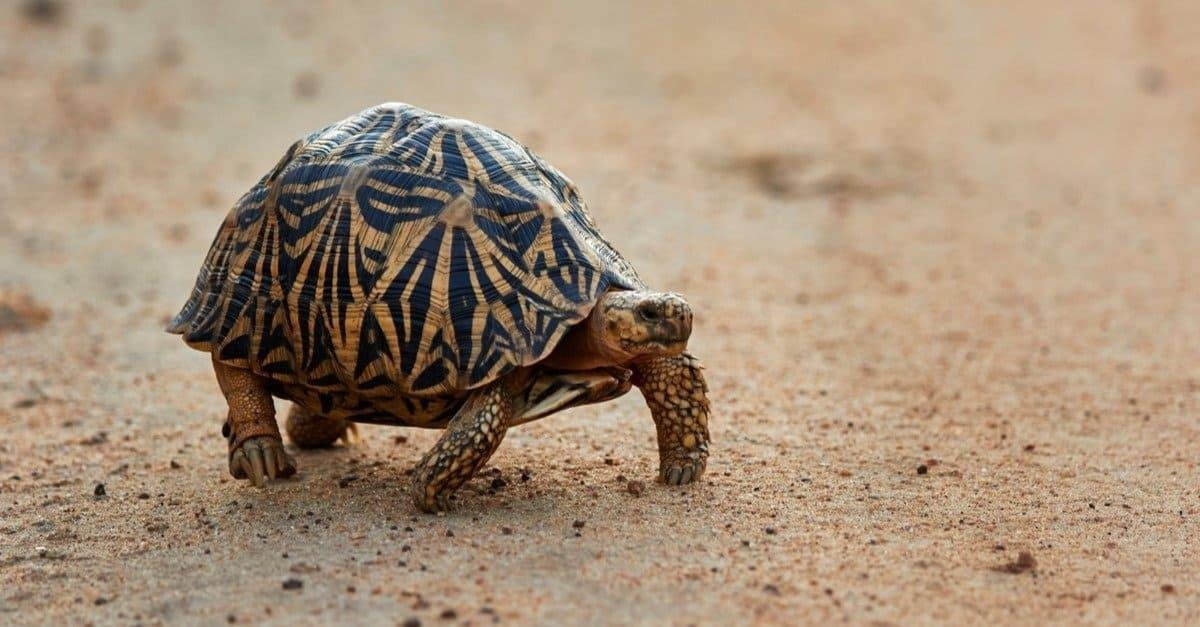
- Recently, a slow-moving Indian Star Tortoise was rescued from a fast-spreading ground fire inside Amrabad Tiger Reserve and safely relocated to another forest patch.
- What is the Indian Star Tortoise?
- It is a medium-sized land-dwelling tortoise.
- Scientific name: Geochelone elegans
- It gets its name from the distinct star-shaped markings on its shell
- These star patterns are not just decorative — they help in camouflage, breaking the outline of the shell so the animal blends into dry vegetation and forest floors.
- Geographic Distribution and Habitat
- This species is naturally found in: India, Pakistan and Sri Lanka
- It mainly inhabits dry regions, scrub forests and open woodland landscapes
- Such habitats make it especially vulnerable to ground fires and habitat degradation.
- Physical Features
- Average length: up to 10 inches
- Females are noticeably larger than males
- Upper Shell (Carapace) has dark brown or black base colour with light yellow or brown rays spread from the centre of each scale, forming star-like designs.
- The pattern varies widely. Some tortoises show a simple “X” shape while others display complex radiating stripes.
- Lifespan: 35 to 80 years
- They do not hibernate but stay inactive during very hot and dry or very cold situations.
- Conservation Status: Vulnerable (IUCM Red List)
- About Amrabad Tiger Reserve (Rescue Location)
- Location: Nallamala Hills of the Eastern Ghats, Telangana
- One of the largest Tiger Reserves in India covering approximately 2600 square km area.
- Earlier, it formed part of the larger Nagarjunasagar–Srisailam Tiger Reserve, before Telangana was formed in 2014.
- The reserve is known for rugged terrain, deep valleys and dense forests.
- Inside the reserve lies the historic Nagalapuram Fort.
- The Krishna River and several perennial streams originate here, supplying water to Srisailam Dam and Nagarjunasagar Dam.
- Main tribal community living here: Chenchu Tribe.
- Flora: Dry Deciduous Forests (Sal, Teak, bamboo, and acacia trees). The forest is also rich in medicinal plants and shrubs, long used by local tribes for traditional healing practices.
- Fauna: Big Cats (Tigers, Leopards and Wildcats) and Herbivores (Sambhar Deer, chital (spotted deer), nilgai (blue bull), wild boar, and the Indian bison (gaur)).
- Over 303 bird species have been recorded, including Eagles, Pigeons and doves, Cuckoos, Woodpeckers and Drongos.
FAQs
Q1. What is the Indian Star Tortoise?
It is a medium-sized land tortoise (Geochelone elegans) named for its star-shaped shell markings that aid camouflage.
Q2. Where is the Indian Star Tortoise naturally found?
In India, Pakistan, and Sri Lanka, mainly in dry scrub forests and open woodlands.
Q3. What are the physical features of the Indian Star Tortoise?
It grows up to 10 inches, females are larger than males, and its shell shows varied star-like patterns. Lifespan ranges from 35–80 years.
Q4. What is the conservation status of the Indian Star Tortoise?
It is listed as Vulnerable on the IUCN Red List due to habitat loss, fires, and illegal trade.
Q5. From where was the recent rescue of the Indian Star Tortoise done?
The rescue of the Indian Star Tortoise was done from inside the Amrabad Tiger Reserve in Telangana’s Nallamala Hills.
Q6. Where is Amrabad Tiger Reserve located?
It lies in the Nallamala Hills of the Eastern Ghats, Telangana, covering ~2,600 sq. km.
Q7. What is the historical background of Amrabad Tiger Reserve?
It was earlier part of the larger Nagarjunasagar–Srisailam Tiger Reserve before Telangana’s formation in 2014.
Q8. What are the key rivers and water systems of Amrabad Tiger Reserve?
The Krishna River and several perennial streams originate here, supplying water to Srisailam and Nagarjunasagar dams.
Q9. Which tribal community resides in Amrabad Tiger Reserve?
The Chenchu Tribe, known for traditional forest-based livelihoods and medicinal plant knowledge.
Q10. What flora and fauna are found in the Amrabad Tiger Reserve?
Dry deciduous forests with Sal, Teak, Bamboo, and Acacia; wildlife includes Tigers, Leopards, Wild Cats, Indian Bison, Sambhar, Nilgai, and over 303 bird species.