- Scientists have recently identified a new carnivorous dinosaur species called Spinosaurus mirabilis from fossil remains found in a remote fossil zone called Jengueb, situated deep inside the central Sahara Desert, in present-day Niger.
- About Spinosaurus mirabilis:
- It lived around 95 million years ago, during the age of dinosaurs.
- At that time, the region was not a desert. It likely consisted of forested landscapes cut by river systems.
- It is the second known species of Spinosaurus. The first known species (Spinosaurus aegyptiacus) was discovered in 1915 from fossils excavated in Egypt.
- Unique Features of the Species:
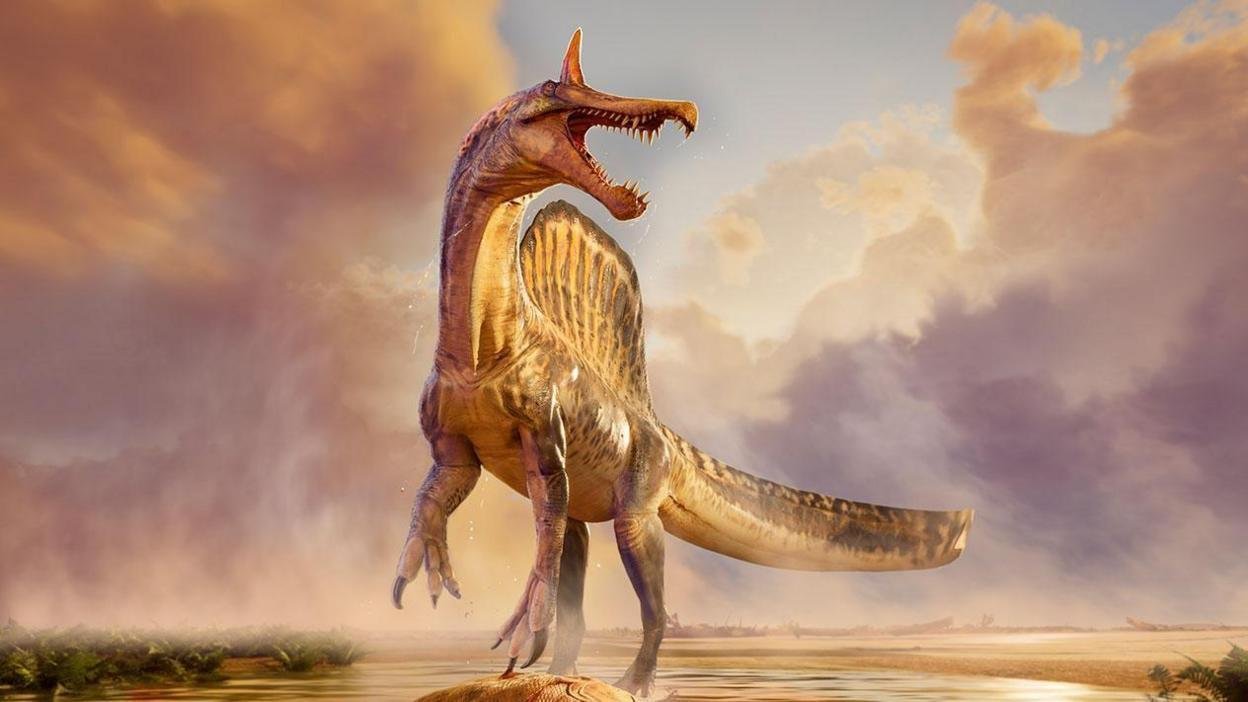
- Cranial Crest: It has a huge, curved, blade-like crest on the skull. The crest resembles a scimitar (curved sword) in shape. Such a structure has never been documented earlier in this dinosaur group.
- Scientists studied the surface texture and internal blood vessel channels and concluded that the crest was likely covered in keratin (same material as horns and nails) and was probably brightly coloured in life, rising upward like a visual signal.
- This suggests the crest was used for display or communication, possibly to attract mates or intimidate rivals.
- Other skull and leg bone remains reveal that Spinosaurus mirabilis was a powerful semi-aquatic predator.
- Key adaptations include interlocking cone-shaped teeth – ideal for gripping slippery prey and long legs – useful for movement on land and in shallow water.
FAQs
Q1. What is Spinosaurus mirabilis?
It is a newly identified carnivorous dinosaur species discovered in Niger’s Sahara Desert, dating back ~95 million years.
Q2. How does Spinosaurus mirabilis differ from Spinosaurus aegyptiacus?
Unlike the earlier Egyptian species, S. mirabilis has a unique curved cranial crest resembling a scimitar, never seen before in this group.
Q3. What was the habitat like during Spinosaurus mirabilis’s time?
The Sahara region was not a desert then; it had forested landscapes with river systems, supporting semi-aquatic predators.
Q4. What was the function of Spinosaurus mirabilis’s crest?
Likely used for display or communication—possibly attracting mates or intimidating rivals—covered in brightly coloured keratin.
Q5. What adaptations made Spinosaurus mirabilis a strong predator?
Interlocking cone-shaped teeth for gripping slippery prey and long legs for movement on land and shallow water.