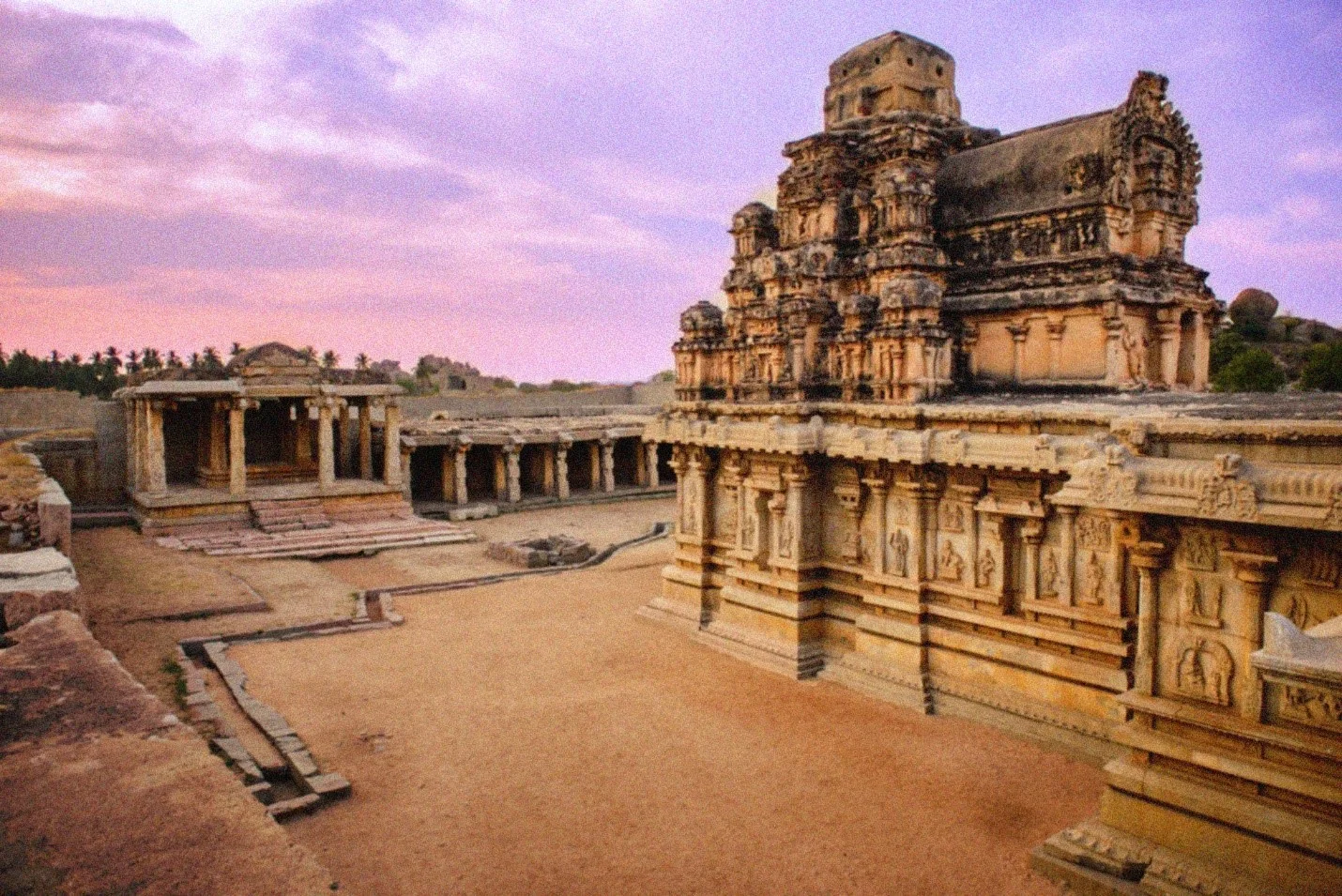
The Vijayanagara Empire (1336–1646 AD), known as the “City of Victory,” stands as one of the most significant Hindu empires in Indian history. Established on the banks of the Tungabhadra River, it served as a bulwark against the northern Sultanates, preserving and patronizing South Indian culture, art, and administrative traditions for over three centuries.
I.Foundation and the Four Dynasties
The empire was founded in 1336 by two brothers, Harihara I (Hakka) and Bukka Raya I. Originally feudatories of the Kakatiyas, they established their independence under the spiritual guidance of the saint Vidyaranya.
The empire’s history is divided into four major dynasties:
| Dynasty | Period | Founder | Key Note |
| Sangama | 1336–1485 | Harihara I & Bukka | Established the core of the empire. |
| Saluva | 1485–1505 | Saluva Narasimha | Short-lived; focused on quelling internal rebellions. |
| Tuluva | 1505–1570 | Vira Narasimha | The Golden Age under Krishnadevaraya. |
| Aravidu | 1570–1646 | Tirumala | Ruled from Penukonda/Chandragiri after the Battle of Talikota. |
II. Prominent Rulers and Their Contributions
1. Deva Raya I (Sangama Dynasty)
- Irrigation: Constructed a massive dam on the Tungabhadra River and a canal-cum-aqueduct to the capital.
- Military: Modernized the army by employing Turkic archers and high-quality Arabian horses.
- Secularism: First king to include 10,000 Muslims in his military.
2. Deva Raya II (Sangama Dynasty)
- Titles: Known as Gajabetegara (Hunter of Elephants).
- Literary Patronage: Wrote Mahanataka Sudhanidhi (Sanskrit). His empire stretched from Ceylon to Orissa.
3. Krishnadevaraya (Tuluva Dynasty)
The most iconic ruler of Vijayanagara, he was an accomplished scholar and warrior.
- Titles: Andhra Bhoja, Andhra Pitamah, and Abhinava Bhoja.
- Literature: Authored Amuktamalyada (Telugu). His court was graced by the Ashta Diggajas (Eight scholars), including Allasani Peddanna and Tenali Ramakrishna.
- Construction: Built the Vittalaswamy and Hazara Ramaswamy temples at Hampi.
III. Administration: The Nayankara System
The empire featured a highly organized and decentralized administrative structure:
- Polity: The King (Raya) held absolute authority but was advised by a council.
- Administrative Units: Divided into Rajyas (Provinces) ->Venthe -> Nadu -> Sthalas -> Gramas (Villages).
- Nayankara System: Military commanders called Nayakas were granted land (Amaram) in exchange for maintaining troops for the King. These governors enjoyed high autonomy, even issuing their own coins.
- Revenue: Land revenue was the primary source of income, generally fixed at 1/6th of the produce.
IV. Economy and Society
The empire was legendary for its wealth, as noted by travelers like Nicolo Conti and Abdur Razzak.
- Economy: Transitioned from agrarian to commercial. Major ports included Goa, Honavar, and Mangalore.
- Exports: Spices, cotton, silk, and rice.
- Imports: Arabian horses, pearls, and Chinese silk.
- Women’s Role: Women were highly active in wrestling, accounting, music, and even astrology. The Sanskrit text Madura Vijayam was authored by Gangadevi.
- Social Norms: Practice of Devadasi (temple dancers) and Sati was present.
V. Art, Architecture, and Literature
Vijayanagara architecture is a vibrant synthesis of earlier Chalukya, Hoysala, and Chola styles, characterized by:
- Key Features: Tall Raya Gopurams (Gateways) and Kalyanamandapams (Marriage halls) with intricately carved monolithic pillars.
- Themes: Pillars often featured the Yali (mythical lion) and scenes from the Ramayana and Mahabharata.
- Literature: Flourished in Kannada, Telugu, Tamil, and Sanskrit. Kannada was the administrative language, while Telugu reached its peak under Krishnadevaraya.
VI. Decline: The Battle of Talikota
The empire’s dominance ended following the Battle of Talikota (1565) (also known as Rakshasi-Tangadi).
- Conflict: A coalition of the Deccan Sultanates (Bijapur, Ahmadnagar, Golconda, and Bidar) defeated the Vijayanagara army led by Rama Raya.
- Impact: The magnificent capital of Hampi was sacked and destroyed. The Aravidu dynasty moved the capital south, but the central authority never fully recovered, leading to the empire’s final dissolution by 1646.
FAQs on the Vijayanagara Empire
Who founded the Vijayanagara Empire?
It was founded by Harihara I and Bukka Raya I in 1336.
What were the four dynasties of the empire?
The Sangama, Saluva, Tuluva, and Aravidu dynasties.
Which ruler built a dam across the Tungabhadra?
Deva Raya I constructed the dam to solve water scarcity in the capital.
Who were the “Ashta Diggajas”?
They were eight eminent Telugu poets in the court of Krishnadevaraya.
What is the “Nayankara System”?
It was a land-grant system where military commanders (Nayakas) governed territories in exchange for military service.
Which traveler described Vijayanagara as one of the wealthiest cities?
The Persian chronicler Abdur Razzak and Italian traveler Nicolo Conti provided accounts of its wealth.
What is a “Raya Gopuram”?
It is a tall, monumental gateway typical of Vijayanagara temple architecture.
In which battle was the empire decisively defeated?
The Battle of Talikota in 1565 against the Deccan Sultanates.
What was the primary language of the Vijayanagara court?
Kannada was used for administration, while Telugu and Sanskrit flourished as literary languages.
Who was the last ruler of the Vijayanagara Empire?
Ranga III (1642–1646) was the last monarch.