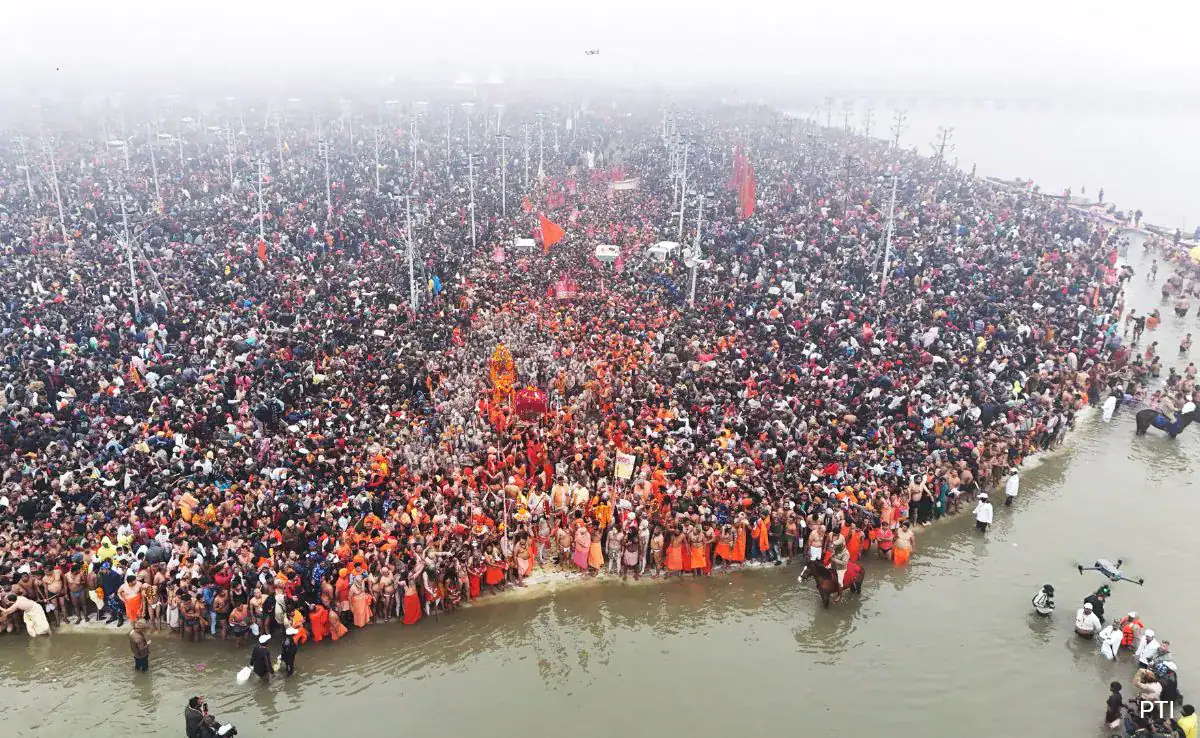
The Kumbh Mela is widely regarded as one of the largest peaceful religious gatherings on Earth. It is a profound expression of Hindu faith, centered on the ritual of sacred bathing. While “Kumbh” and “Maha Kumbh” are often used interchangeably in casual conversation, they represent distinct tiers of spiritual significance, astrological timing, and rarity.
The Mythological Origin: Samudra Manthan
The tradition of the Kumbh Mela is rooted in the ancient Puranic legend of Samudra Manthan (the churning of the primordial ocean). According to Hindu scriptures, a struggle ensued between the Devas (Gods) and Asuras (Demons) over a pot (Kumbh) containing the nectar of immortality (Amrit).
During this celestial chase, four drops of the nectar fell at four specific locations on Earth: Haridwar, Prayagraj, Nashik, and Ujjain. Consequently, these four sites became the holy venues for the Mela, where the water is believed to turn into nectar during specific planetary alignments.
Classification and Frequency of the Melas
The occurrence of the Kumbh Mela is determined by the complex astrological positions of the Sun, Moon, and Jupiter. Depending on the cycle, the Mela is classified into four distinct types:
| Type | Frequency | Primary Locations | Significance |
| Kumbh Mela | Every 4 Years | Rotates among all four sites | A frequent gathering for purification and spiritual rejuvenation. |
| Ardh Kumbh Mela | Every 6 Years | Haridwar and Prayagraj | “Ardh” means half; it marks the halfway point between Purna Kumbhs. |
| Purna Kumbh Mela | Every 12 Years | All four sacred sites | Held when Jupiter enters Leo or Aquarius, attracting millions. |
| Maha Kumbh Mela | Every 144 Years | Exclusively at Prayagraj | Occurs after 12 cycles of Purna Kumbh; the rarest spiritual event. |
Maha Kumbh Mela: The Rarest Gathering
The Maha Kumbh is considered the “Ultimate Pilgrimage.” It takes place only at Prayagraj (the Sangam or confluence of the Ganga, Yamuna, and the mythical Saraswati).
- Rarity: It occurs after 144 years, making it a once-in-a-lifetime (or once-in-many-generations) opportunity for a devotee.
- Duration: Typically spans several months, significantly longer than a standard Kumbh.
- Shahi Snan: The “Royal Bath” taken by the various Akharas (orders of saints and sadhus) is the pinnacle of this event.
- Cultural Recognition: In 2017, UNESCO inscribed the Kumbh Mela onto the Representative List of the Intangible Cultural Heritage of Humanity, acknowledging its immense social and spiritual impact.
Key Differences: Kumbh vs. Maha Kumbh
| Aspect | Kumbh Mela | Maha Kumbh Mela |
| Frequency | Every 4 years (on a rotational basis). | Once every 144 years (12 x 12 cycles). |
| Location | Rotates between Haridwar, Prayagraj, Nashik, and Ujjain. | Held exclusively at Prayagraj. |
| Scale | Large religious gathering. | One of the largest human congregations in recorded history. |
| Spiritual Weight | Major religious festival for purification. | Ultimate spiritual experience; believed to provide absolute salvation (Moksha). |
| Recent/Upcoming | Ujjain Simhastha scheduled for 2028. | Last held in 2025. |
Core Rituals and Activities
Regardless of the type, the following activities define the spiritual core of the Kumbh:
- Sacred Dip (Snan): Believed to cleanse the soul of past sins and break the cycle of birth and death.
- Shahi Snan (Royal Bath): The most auspicious bathing dates where the Naga Sadhus and leaders of different Akharas lead the procession.
- Satsang and Kalpavas: Many devotees live in temporary tents on the riverbanks for a month, leading a minimalist, spiritual life.
- Peshwai: The grand arrival of the seers and saints on elephants, horses, and chariots, showcasing India’s vibrant religious diversity.
FAQs on Kumbh and Maha Kumbh
What is the primary difference between Kumbh and Maha Kumbh?
The primary difference is frequency; the Kumbh Mela occurs every 4 years, while the Maha Kumbh occurs only once every 144 years at Prayagraj.
What are the four locations where the Kumbh Mela is held?
The four sacred sites are Haridwar (Uttarakhand), Prayagraj (Uttar Pradesh), Nashik (Maharashtra), and Ujjain (Madhya Pradesh).
Which organization recognized the Kumbh Mela as Intangible Cultural Heritage?
UNESCO inscribed the Kumbh Mela on its Representative List of Intangible Cultural Heritage of Humanity in 2017.
When was the most recent Maha Kumbh Mela held?
The most recent Maha Kumbh Mela was held in Prayagraj in early 2025.
What is the significance of the Shahi Snan?
The Shahi Snan, or Royal Bath, is the most auspicious ritual where saints of various Akharas take the first dip in the sacred river.
How often does the Ardh Kumbh Mela occur?
The Ardh Kumbh Mela is held every 6 years, but only at Haridwar and Prayagraj.
On which river is the Ujjain Kumbh Mela celebrated?
The Ujjain Simhastha Kumbh is celebrated on the banks of the Shipra River.
What is the mythological story behind the Kumbh Mela?
It is based on the Samudra Manthan (churning of the ocean) where drops of the nectar of immortality fell at four locations.
How many Purna Kumbh cycles make up one Maha Kumbh?
A Maha Kumbh is celebrated after the completion of 12 Purna Kumbh cycles (12 x 12 = 144 years).
When will the next Simhastha Kumbh be held?
The next Simhastha Kumbh Mela is scheduled to be held in Ujjain in 2028.