- Due to climate change, cities are experiencing rising average temperatures, more frequent and intense heatwaves and longer summers, leading to increased cooling demand everywhere (homes, malls, factories, buildings, etc).
- If every building installs its own air-conditioning system, it leads to extremely high electricity consumption, increased carbon emissions, high maintenance and operating costs, duplication of infrastructure and overall inefficient energy use.
- To solve this growing problem, urban planners are promoting a system called District Cooling.
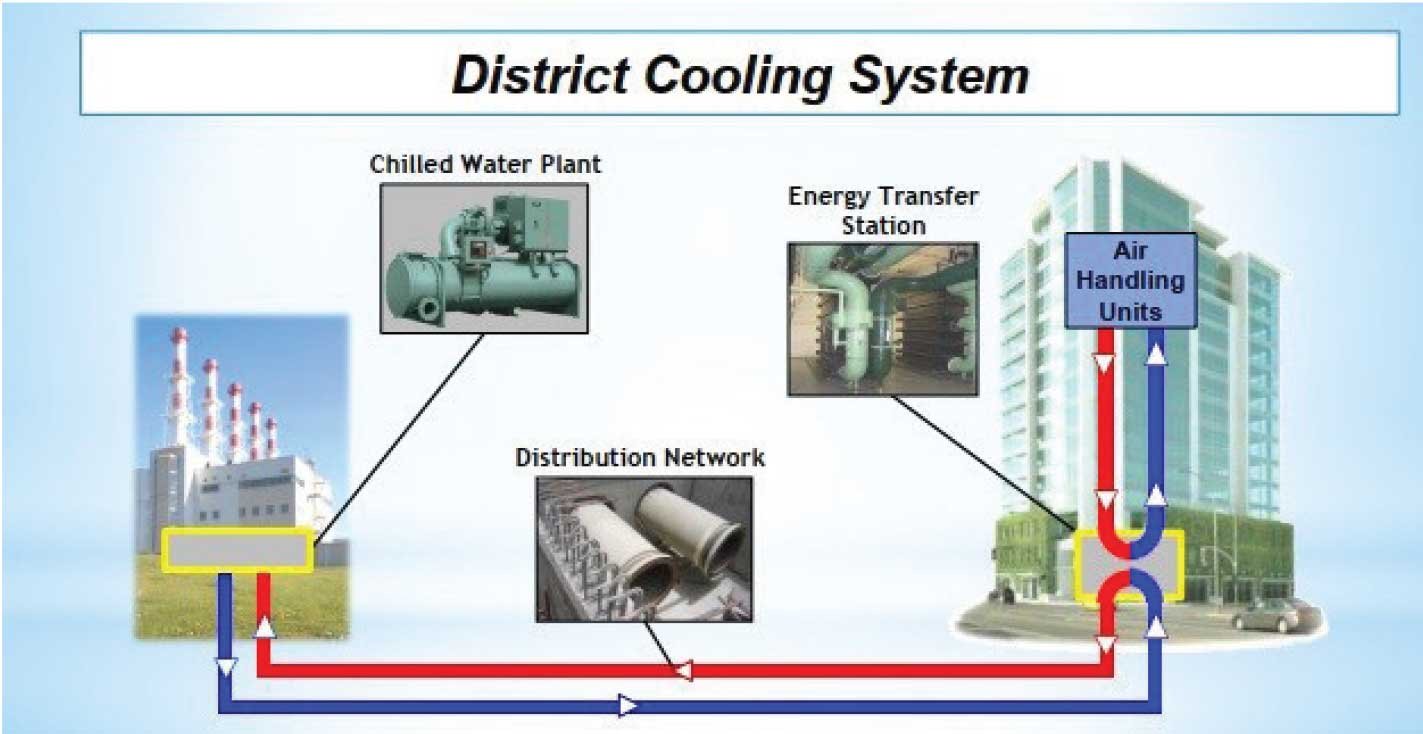
- What is District cooling: It is a centralized cooling system where instead of installing separate AC units in each building, a large central cooling plant produces chilled water which is used to cool the indoor air.
- How district cooling works?
- Central Production: A central plant generates chilled water using large industrial chillers.
- Distribution: The chilled water travels through well-insulated underground pipes (to prevent temperature loss) to multiple buildings in a defined area (like township, SEZ, large residential complexes).
- Building-Level Exchange: Each connected building uses a heat exchanger system. The chilled water absorbs indoor heat and cools the air.
- Return Cycle: The warmed water returns to the central plant.
- Re-cooling: The plant cools the water again, and the cycle continues, creating a closed-loop cooling network.
- Why District Cooling Is Important?
- Saves electricity as large central plants have higher efficiency than small AC systems.
- Reduces carbon emission as less fossil fuel is consumed.
- Central systems can handle extreme heat conditions better than scattered units.
- It helps avoid infrastructure duplication.
- As data centres and AI facilities expand, cooling demand will rise sharply. District cooling provides scalable capacity.
- Global Comparison: In several European countries, centralized district heating systems already exist. District cooling works on the same principle – but instead of heat, it supplies cooling.
- District Cooling represents a major step toward building climate-smart and energy-efficient cities of the future.
FAQs
Q1. What is district cooling?
It is a centralized system where a large plant produces chilled water to cool multiple buildings through underground pipes.
Q2. How does district cooling work?
Chilled water is generated at a central plant, distributed via insulated pipes, used in buildings to absorb heat, and then returned for re-cooling.
Q3. Why is district cooling better than individual ACs?
It saves electricity, reduces carbon emissions, avoids infrastructure duplication, and is more efficient.
Q4. Where is district cooling most useful?
In townships, SEZs, large residential complexes, malls, and data centers with high cooling demand.
Q5. How is district cooling similar to district heating in Europe?
Both are centralized systems; district heating supplies warmth, while district cooling supplies chilled water for cooling