Context
Sakurajima in southern Japan recently produced fresh ash plumes, continuing its ongoing phase of active volcanism. As of 30 October 2026, Japan’s Meteorological Agency maintained Volcanic Alert Level 3, restricting access near the crater.
Location and Tectonic Setting
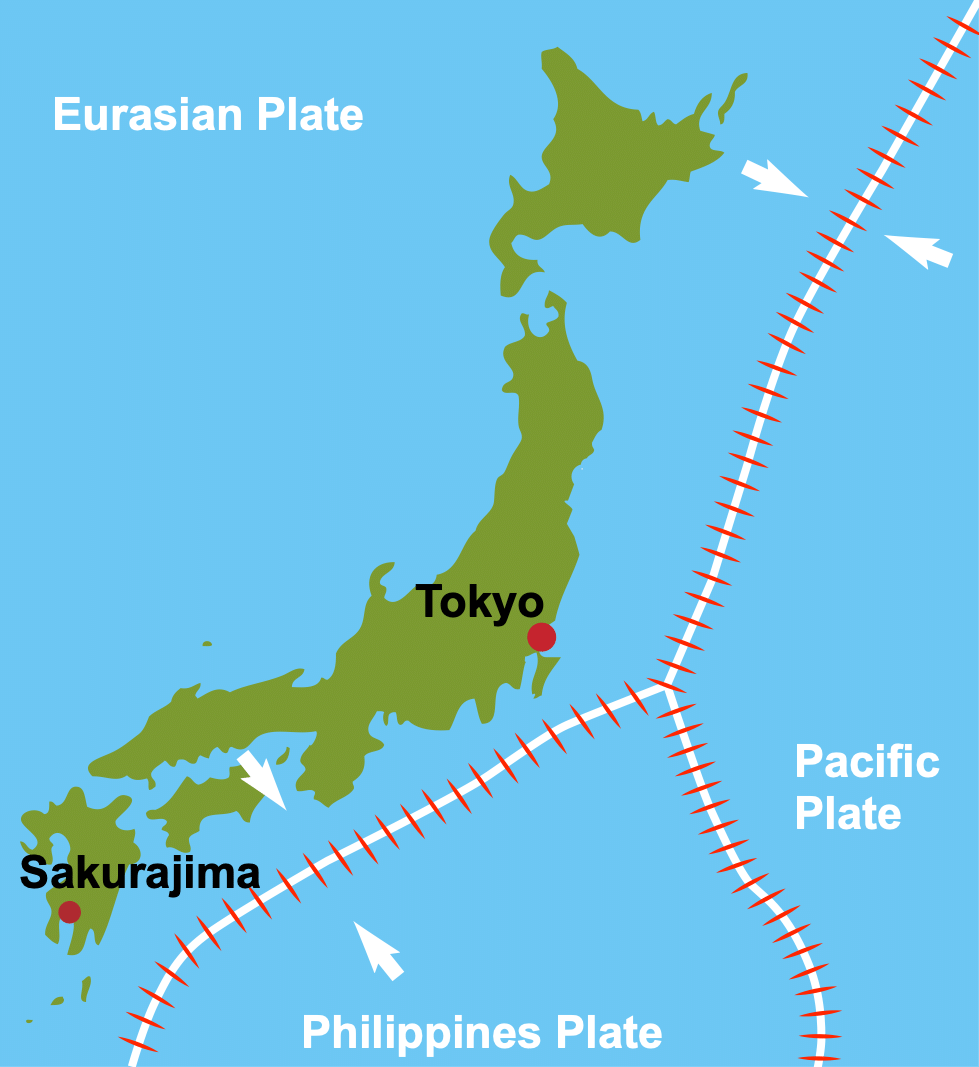
- Location: Sakurajima lies in Kagoshima Bay, close to Kagoshima City in southern Kyushu, Japan, placing a highly active volcano near a densely populated urban area.
- Aira Caldera: It sits on the southern rim of the Aira Caldera, linking Sakurajima to a larger volcanic system in northern Kagoshima Bay.
- Subduction setting: Sakurajima forms part of Japan’s subduction-zone volcanic arc, where converging tectonic plates generate magma and frequent volcanic activity.
- Volcano type: It is an andesite–dacite composite volcano, built by repeated eruptions of lava, ash and other pyroclastic material.
Structure and Composition
- Main volcanic edifices: JMA identifies Kitadake and Minamidake as the two main volcanoes, while Nakadake is a central parasitic peak.
- Highest point: Kitadake/Ontake reaches about 1,117 metres, while Minamidake rises to about 1,060 metres.
- Active crater: Historical and modern summit eruptions have mainly occurred at Minamidake, while the Showa crater has also shown activity in recent decades.
- Magma character: Its andesite–dacite composition produces relatively viscous magma, favouring pressure build-up and explosive eruptions.
Eruption History and Hazard
- Formation: Sakurajima began developing around 13,000 years ago on the southern margin of the Aira Caldera.
- 1914 Taisho eruption: Sakurajima was formerly an island; lava from the 1914 eruption filled the Seto Strait, connecting it to the Osumi Peninsula.
- Persistent activity: Frequent summit eruptions at Minamidake resumed in 1955, making Sakurajima one of Japan’s most persistently active volcanoes.
- Eruption style: Many modern eruptions are Vulcanian, producing short explosive bursts of ash, gas and volcanic blocks.
- Current hazard: JMA warns of ballistic blocks, pyroclastic flows, ashfall and rain-triggered lahars around the volcano; recent eruptions have sent ash plumes more than 2 km above the crater.
FAQs
Q1. Where is Sakurajima located?
In Kagoshima Bay, southern Kyushu, Japan.
Q2. Which caldera is Sakurajima associated with?
The Aira Caldera.
Q3. What type of volcano is Sakurajima?
An andesite–dacite composite or stratovolcano.
Q4. Which crater is the main centre of modern activity?
The Minamidake summit crater.
Q5. How did Sakurajima become connected to Kyushu?
Lava from the 1914 Taisho eruption filled the Seto Strait and joined it to the Osumi Peninsula.