Context
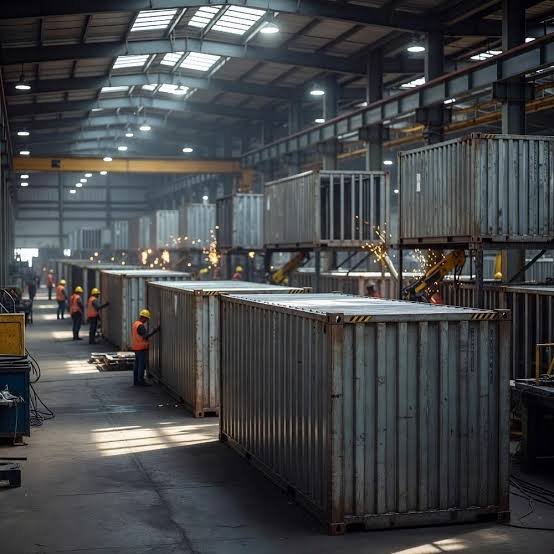
The Union Cabinet approved the Container Manufacturing Promotion Scheme (CMPS) on 28 October 2026, with an outlay of ₹10,000 crore up to FY 2039-40, to promote domestic container manufacturing and reduce import dependence, particularly on China.
About the Scheme
- Core Objective: Scale up domestic container manufacturing capacity from 70,000 TEUs to 7.5 lakh TEUs annually (nearly tenfold expansion).
- Technical Unit (TEU): Uses TEU (Twenty-foot Equivalent Unit) as the standard measure (1 TEU = standard 20-foot container; 2 TEUs = 40-foot container).
- Implementation Timeline: Operational from FY 2027–28 to FY 2039–40 (includes 3 years for infrastructure setup and 10 years of production incentives).
- Economic & Employment Impact: Projected to generate 3,000 direct and 50,000+ indirect jobs, driving ₹75,000 crore in cumulative economic output by FY 2039–40.
- Nomenclature & Evolution: Formerly proposed as CMAS (Container Manufacturing Assistance Scheme), now officially approved as CMPS (Container Manufacturing Promotion Scheme).
Key Features
- Financial Assistance Components: Total scheme allocation of ₹10,000 crore split across:
- OEA (Operational Expenditure Assistance): Allocation of ₹8,891 crore to provide direct production incentives for quality-certified containers (₹49,500 per 20-ft TEU and ₹86,625 per 40-ft container).
- ISA (Interest Subvention Assistance): ₹859 crore providing a 3% interest subsidy on term loans.
- Testing & Quality Assurance: ₹150 crore to build shared testing facilities for global certification.
- Administration: ₹100 crore set aside for scheme management.
- Infrastructure & Land Support: Major Port Authorities will lease land at 25% of notified rates.
- Eligibility Thresholds:
- Greenfield (New) Units: Minimum annual capacity of 1 lakh TEUs.
- Brownfield (Existing Expansion) Units: Minimum capacity addition of 25,000 TEUs.
- Domestic Content Requirement: Mandates local sourcing of 70% minimum content up to FY 2031–32, increasing to 90% from FY 2032–33 (boosting domestic steel, component, and paint industries).
Why India Needs It
- Heavy Import Dependence: India relies heavily on foreign container imports, causing significant forex (foreign exchange) outflows.
- Supply-Chain Concentration: China accounts for ~95% of global container production, exposing global trade to single-source risks.
- Vulnerability to Supply Shocks: Crises like COVID-19 and the Red Sea disruption triggered severe container shortages, shipment delays, and spiking freight rates.
- Critical Trade Exposure: Maritime shipping handles 95% of India’s trade volume and 70% of trade value.
- Bridging the Cost Gap: Offsets the higher production cost of Indian containers relative to Chinese imports through targeted subsidies.
Significance
- Supply-Chain Resilience: Mitigates reliance on a single dominant supplier, safeguarding national logistics.
- Forex Savings & Export Hub: Saves foreign exchange reserves and positions India as a net exporter of containers (capacity target of 5 lakh TEUs exceeds local demand).
- Industrial Multiplier Effect: Stimulates growth and job creation across allied sectors—including domestic steel, industrial paints, and component manufacturing.
- Maritime Amrit Kaal Alignment: Directly accelerates India’s transition into a self-reliant global maritime and logistics hub.
- Domestic Fleet Standardization: Enhances the availability of standardized container stock, reducing inland container turnaround times and lowering domestic freight logistics costs.
Key Challenges
- Inability to Match Chinese Economies of Scale: High domestic input costs make Indian containers structurally more expensive than Chinese imports.
- Risk of Long-Term Subsidy Dependence: Potential failure of manufacturing units to achieve self-sustaining commercial viability once government incentives end.
- Vulnerability to Global Trade Cycles: Exposure to sharp fluctuations in international shipping demand and global economic slowdowns.
- Supply-Chain Bottlenecks in Meeting DVA: Difficulty in scaling domestic steel and component production fast enough to meet the 90% DVA (Domestic Value Addition) mandate.
- Hurdles in Scaling Up to International Standards: Stringent global certification processes and strict compliance requirements pose operational barriers to rapid expansion.
Way Forward
- Cost Optimization: Enhance logistical efficiency and input supply to narrow the production cost gap.
- R&D (Research and Development) & Skill Building: Invest in advanced container design, manufacturing tech, and workforce training.
- Ancillary Ecosystem Development: Promote domestic supply chains to seamlessly achieve high DVA (Domestic Value Addition) thresholds.
- Focus on Self-Reliance: Utilize the 10-year support window to build commercially viable, self-sustaining manufacturing units.
- Market & Demand Diversification: Secure long-term supply contracts and target global export markets to mitigate cyclical trade shocks.
FAQs
Q1. What is the Container Manufacturing Promotion Scheme?
Ans. A ₹10,000 crore scheme to promote domestic container manufacturing and reduce import dependence, running up to FY 2039-40.
Q2. What capacity target does the scheme set?
Ans. It aims to increase annual manufacturing capacity nearly ten-fold, from 70,000 TEUs to 7.5 lakh TEUs.
Q3. Why does India want to reduce reliance on imported containers?
Ans. To reduce foreign exchange outflows and supply-chain risks arising from China’s dominance and global disruptions.